Six months of expenses is £58,800 for the Okafors, so they saved nothing, which is what an impossible number is for. If Femi’s job went, the income would fall to Grace’s £4,200 against fixed costs of £4,790: £590 a month. Four months of that is £2,360.
Grace and Femi Okafor. The households in these Shorts are illustrations built from typical UK figures, not real people, and every number below is worked on the household’s sheet.
What happened
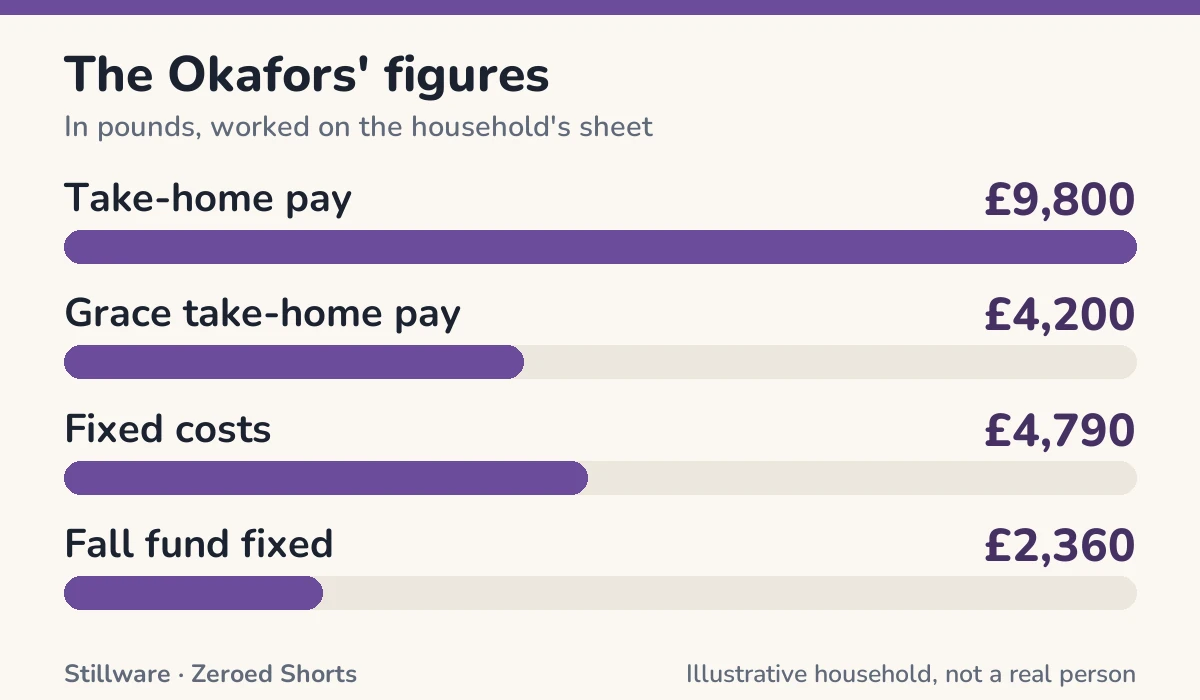
Grace and Femi Okafor wanted to know how many months of expenses they should keep as an emergency fund. They have two teenagers and take home £9,800 a month. Six months of expenses, the way the usual advice puts it, is six times that figure: £58,800. They looked at the number and did nothing, which is exactly what an impossible number tends to produce.
The trouble was the question itself. Asking how many months to save assumes the answer is a multiple of everything. The more useful question is different: how far does the income actually fall, and against what?
If Femi lost his job, the household income would not drop to zero. It would drop to Grace’s take-home, which is £4,200. And the costs that genuinely need protecting are the fixed ones: the mortgage, the bills, food, the cars and the support they give Grace’s mother. Those come to £4,790 a month. So the real fall, measured against fixed costs, is £590 a month. Not the whole income, just £590.
If it took four months to find the next role, the shortfall would be £2,360. That is the size of the fund. And it turned out to be money they already had sitting in the current account.
That is the turn. The textbook figure assumes two things at once: that the whole income disappears, and that the lifestyle carries on unchanged. For a household with two incomes, neither is true. If one job goes, the lifestyle is what pauses. The holidays, the meals out and the extras wait. The fixed costs are what the fund is there to protect. And the second income is the first line of defence, not the fund itself.
The calculation fits in one line. Take the income that would remain after the fall, subtract the fixed costs, and multiply by the months it would take to recover. For many two-income households that number turns out to be reachable within the year, rather than something that sits untouched because it looks too large to start. For the Okafors it was about four percent of the textbook answer.
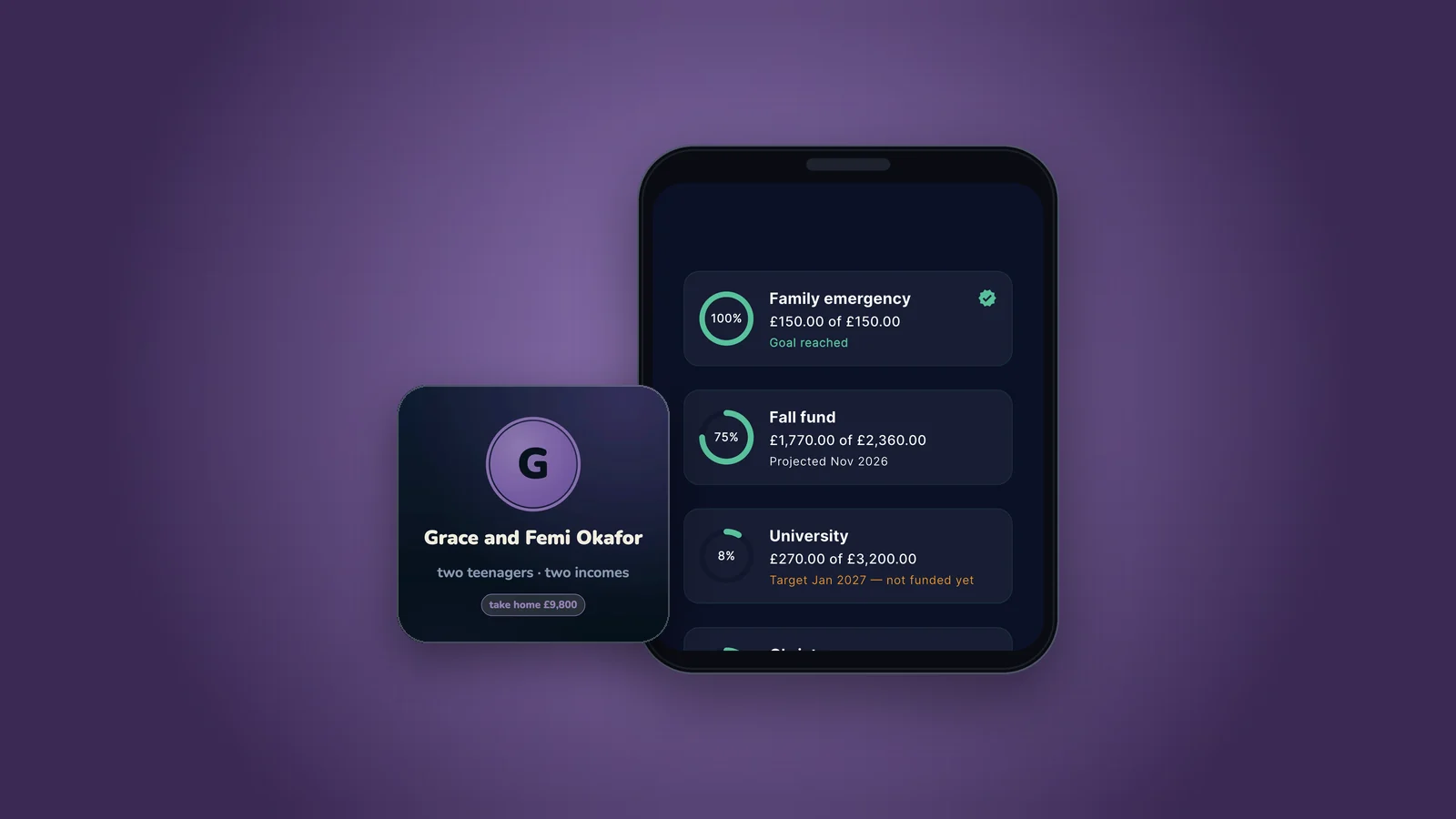
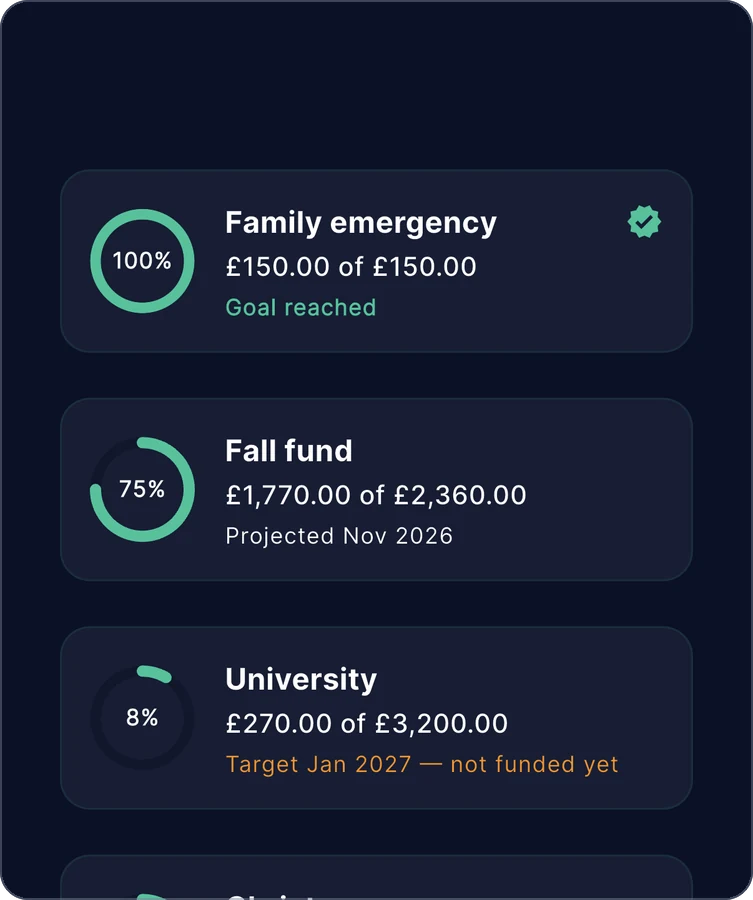
Their fall fund now has a goal of £2,360, and it is already three-quarters full. Instead of staring at £58,800 and doing nothing, they are filling a number they can actually reach.
The working
Every figure the Short says, and where it comes from on the household’s sheet.
| The Short says | Figures | Derivation |
|---|---|---|
| fifty-eight thousand eight hundred | takehome * 6 | on the sheet |
| about four percent of that | round(fall_fund_fixed / lifestyle_fund_6m * 100) = 4 | on the sheet |
| nine thousand eight hundred | takehome = 9,800 | on the sheet |
| six times nine thousand eight hundred | takehome * 6 | on the sheet |
| four thousand two hundred | grace_takehome = 4,200 | on the sheet |
| four thousand seven hundred and ninety | fixed_costs = 4,790 | fixed_costs = mortgage + bills + groceries + cars + parent_support |
| five hundred and ninety a month | fixed_costs - grace_takehome | on the sheet |
| four months / two thousand three hundred and sixty | fall_months = 4; fixed_gap_after_fall * fall_months | on the sheet |
The turn
The textbook number assumes the whole income disappears and the lifestyle stays; for a two-income household, neither is true.
The Short
Monday
- The income after the fall, minus fixed costs, times the months to recover.
- That is the number, and it is usually reachable this year.
In Zeroed
the Okafors’ Fall fund is a goal of two thousand three hundred and sixty, three-quarters full. So they are filling a number they can reach, not fifty-eight thousand eight hundred.
Zeroed: Offline Budget Planner is the app in the Short — envelope budgeting you buy once. It works offline, with no bank login, no subscription and no data harvesting; the first thirty-four days are free, no card needed. Try Zeroed.