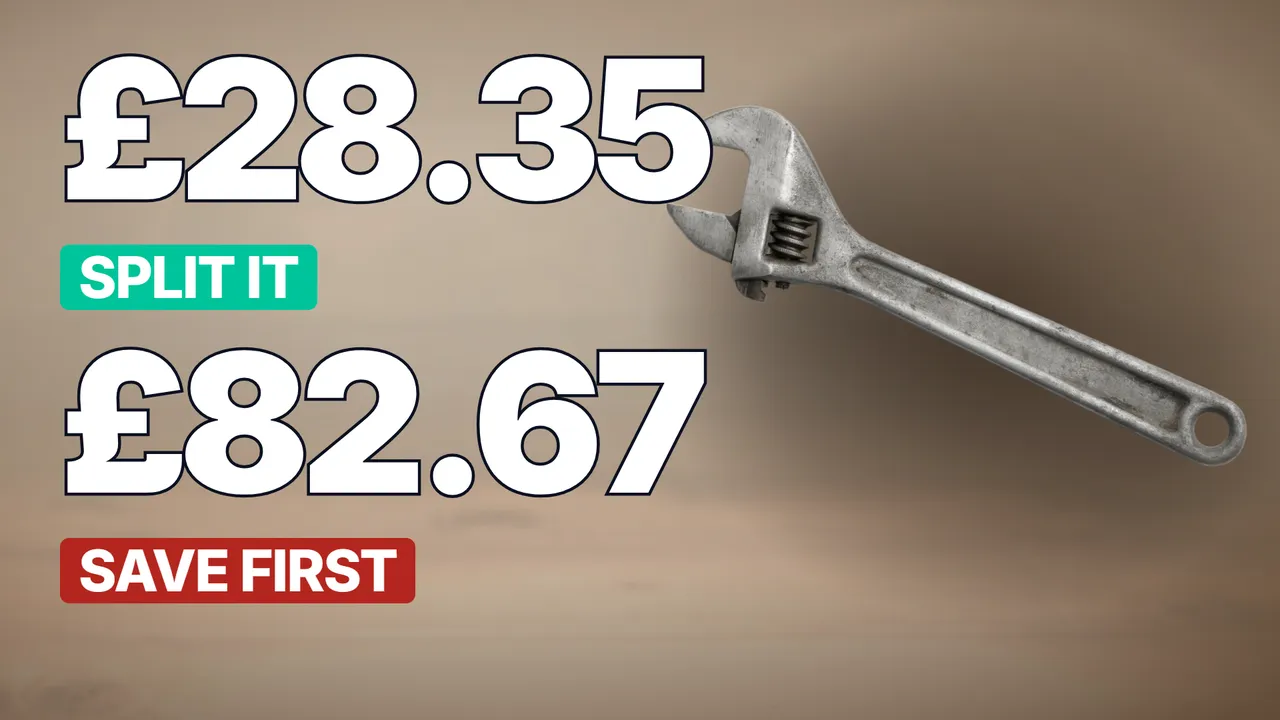
The short answer: do both, and it costs less than you think. On a £3,000 credit card at 24.7% APR with £200 a month spare, putting £50 into a buffer and £150 at the card — instead of all £200 at the card — leaves you £28.35 worse off after a year. That is the whole price of having an emergency fund while you clear a debt. And it is not a fixed price: it falls as your savings rate rises, and at about 4.5% it disappears entirely.
Why the usual advice is unsatisfying
Search this question and you get the same shape of answer from everyone, including sources far more authoritative than us: clear expensive debt first, keep your minimums up, build a modest buffer, then a bigger one. It is correct. It is also unfalsifiable, because it never says what the choice costs, and so it never tells you whether the buffer is worth it in your situation.
The maths camp is right that every pound in a savings account earning 4.5% while a card charges 24.7% is a pound working against you. The safety camp is right that a person with no buffer puts the next emergency straight back on the card. Both are true. The question neither answers is: how much does the safety cost?
The worked example
One household, one month, three ways of spending the same £200.
| Plan A: all at the card | Plan B: save first | Plan C: split £50 / £150 | |
|---|---|---|---|
| Card balance after 12 months | £1,601 | £2,652 | £1,983 |
| In the buffer after 12 months | £0 | £968 | £353 |
| Interest paid over the year | £601 | £1,251 | £619 |
| Cost vs Plan A | — | £82.67 | £28.35 |
The inputs, so you can check it against your own numbers: a starting balance of £3,000, an APR of 24.7% charged monthly on the balance, £200 spare each month, and a savings rate of 4.5% AER on the buffer. Plan B pays only the card’s minimum (the greater of £25 or 1% of the balance plus interest).
Two things fall out of that table that the staged advice never gets to.
Plan B is genuinely expensive. Saving first and paying minimums costs £82.67 over the year and leaves you owing £2,652. If you are choosing between “all savings” and “all debt”, the arithmetic is not close.
Plan C is nearly free. Doing both costs £28.35 — about 55p a week — and buys you £353 of cash you can reach without borrowing. That is the number the argument has been missing.
The rate where it costs nothing
The £28.35 is not a constant. It is the difference between what the card charges you and what the buffer earns you, on the money you diverted. So it shrinks as your savings rate rises, and there is a rate at which it reaches zero.
For this household that rate is roughly 4.5% — which happens to be about what a decent UK easy-access account pays at the moment. Above it, the split is free or better. Below it, you are paying the small premium in the table.
So the honest rule is not “always clear debt first”. It is:
Compare what your debt charges you with what your savings actually earn. If the debt costs more, every spare pound belongs on the debt — and the buffer is a deliberate purchase, not an arithmetic mistake.
The word actually is carrying weight there. Most people are not earning 4.5%: money sitting in a current account earns close to nothing, which pushes the cost of the split back up. Check the rate you are really getting, not the one on the advert.
What the buffer is actually for
A buffer is not savings and it should not behave like savings. It is a rule with a ceiling: absorb the emergency, never borrow for it, and stop when it is full.
Give it a target — £500 works for a household like this one — and when it reaches that target the whole £200 goes back to the card. Decided once, so you never have to decide it again. People who treat the buffer as a savings account keep feeding it forever, and that is where the split stops being nearly free and starts being Plan B.
The buffer’s job is visible in month five of the worked year: the boiler goes, it costs £400, and the household with a buffer opens it and pays. The household without one puts £400 back on a card at 24.7% and undoes months of progress. Those late fees and over-limit charges are not in our table, which means the table is, if anything, unkind to the buffer.
Where this stops being a budgeting question
If the gap is bigger than your spare money — if there is nothing left after rent, council tax, energy and food — then no ordering of envelopes fixes it, and the honest next step is free advice rather than a better spreadsheet. StepChange and Citizens Advice are free and independent. There is no shame in it and it is what they exist for.
There is also one clean exception to everything above. If the debt is on a 0% card, or is a cheap student loan, the comparison flips: the debt costs less than the savings earn, and building the fund first genuinely wins. The rule handles that case correctly, which is how you know it is a rule and not a slogan.
Doing it on paper
You do not need software for this.
- Write down two numbers: what your debt charges you, and what your savings actually pay you.
- If the debt costs more, the arithmetic says every spare pound belongs on the debt. That is Plan A and nothing beats it.
- Decide whether you want a buffer anyway. Price it: on a £3,000 card at 24.7%, splitting £50/£150 costs about £28 over a year.
- Give the buffer a ceiling — £500 here — so it is a stage, not a destination.
- Assign the split on the day the money lands, not at the end of the month.
- When the buffer is full, send the whole amount back to the debt.
Two envelopes and one split rule. That is the entire method, and it works on paper exactly as it works in an app. The debt payoff calculator will run the £150-a-month route on your own balance and rate, free, in the browser.
Doing it in Zeroed
I built Zeroed to run exactly this: give every pound a job on the day it arrives, including the pound that goes to the card. Two envelopes — Emergency Fund and Card Payment — assigned on payday, and the header reads zero when the whole £200 has been placed. It is one payment rather than a subscription, it works offline, and it never asks for your bank login.
The method above does not need it. If you would rather run two envelopes on paper, the numbers are identical.
Frequently asked questions
How big should the emergency buffer be while I still have debt? Small and capped. £500 covers the ordinary bad Tuesday — a boiler, a tyre, a vet bill — which is what stops the emergency going back on the card. Three-to-six months of expenses is a target for after the expensive debt is gone, not during.
Does this work with more than one debt? Yes. Run the comparison against your highest rate, because that is the one your spare pound is competing with. The split then sits alongside whichever payoff order you are using.
What if my savings are in a current account? Then your real savings rate is close to zero and the split costs you more than £28.35. Either move the buffer to an easy-access account paying something, or accept the higher price knowingly.
Is £28.35 the number for me? Almost certainly not — it is this household’s number. What transfers is the method: price your own split before you argue about it, and compare your two rates rather than following a rule of thumb.
This is education about a budgeting method, not financial advice.