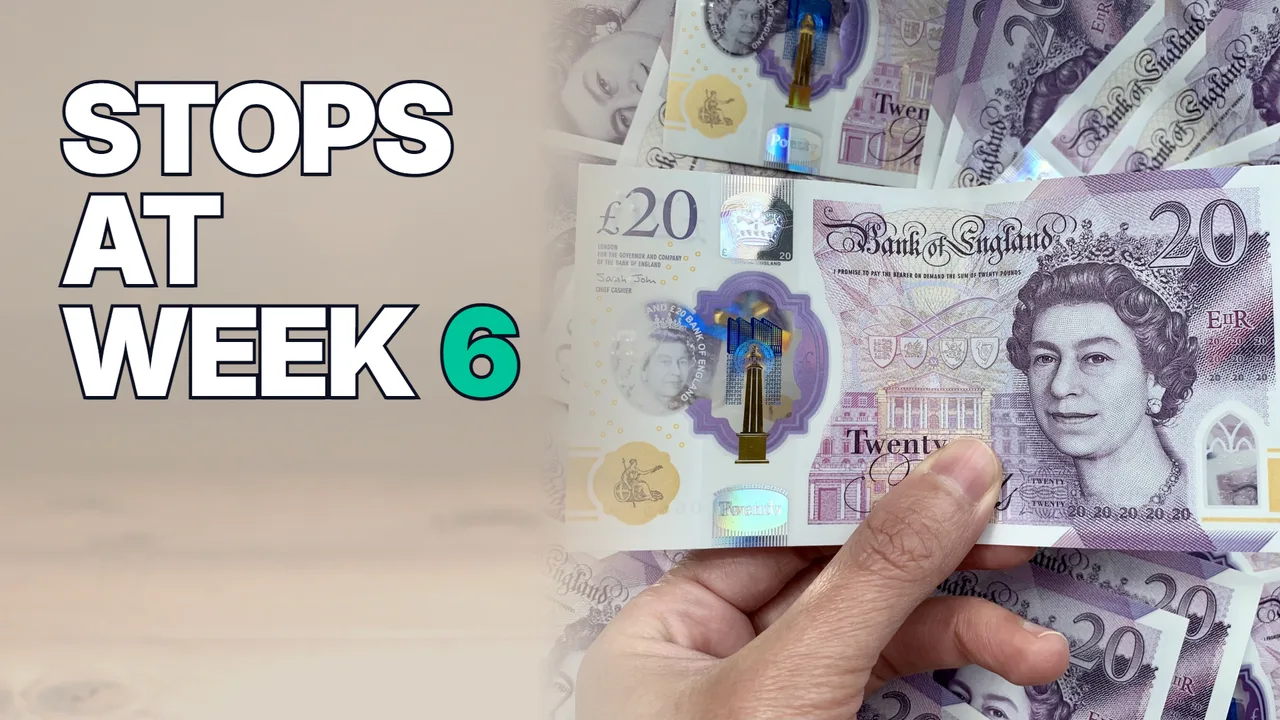
Cash stuffing usually fails around week six, and it is not a discipline problem. Rent leaves by bank transfer, the shopping moves online, and a drawer of uncounted change makes the envelopes untrustworthy. The fix is a split: keep the one or two envelopes where handing over notes actually stops you in cash, and run everything else from last month’s bank statement, with every pound assigned before the month starts. One evening to set up, ten minutes a month to keep.
The video walks the whole month with a real statement. This page is the reference version: the numbers, the steps and the questions people ask afterwards.
What actually breaks in week six
Go back to payday in January. You drew the cash and filled six envelopes. For this household, a single UK renter on £2,400 a month, that looked like this:
| Envelope | January amount | How it gets paid |
|---|---|---|
| Groceries | £250 | Cash, then increasingly card and online |
| Eating out | £80 | Cash |
| Fun money | £60 | Cash |
| Transport | £120 | Cash, then contactless |
| Rent | £950 | Bank transfer on the 1st |
| Bills (electric, phone, streaming) | £180 | Direct debit and card |
The first crack is already in that table. Rent and bills are the biggest chunk of the money, and they never touch an envelope. They leave the account without touching your hands, so they never get budgeted. They get tolerated.
Then the second crack. We ran a real month’s statement through this: 94 transactions. Forty-one of them could never have been cash. Not wouldn’t. Couldn’t. Online orders that only take a card, subscriptions, a delivery, a top-up. Nothing comes out of an envelope for any of them.
The third crack is the shop wanting £13.47 from a £20 note. The change pile starts, and the moment you stop trusting what is in the envelopes, you stop counting them. That is week six.
The part of cash stuffing that is still true
Handing over notes hurts. Tapping a card does not. Watching an envelope go thin changes what you do next, and no number on a screen does that quite as well. Cash stuffing works for exactly as long as your spending is the kind of spending cash can pay for. So the fix is not to abandon cash. It is to keep cash exactly where that feeling matters, and nowhere else.
The two-envelope fix, step by step
You need three things: last month’s bank statement as a PDF or CSV, the names of your six envelopes, and one evening. Everything below works on paper or in any envelope app.
Step 1. Put the same six envelopes on a screen
Money lands, and you give every pound a job. Sixty to groceries, eighty to eating out, and so on until the number at the top reaches zero before the month starts. Same rule as the binder, same envelopes, just not made of paper.
Step 2. Budget the money that never touched your hands
Rent, electric and phone go in as scheduled bills on the day they leave. They are funded on payday, which means the envelope for the rest of the month is finally honest. This is the step the binder never had: the biggest expenses stop being invisible.
Step 3. Log a spend and watch the envelope go thin
An £18 lunch takes Eating Out from £80 to £62. A small marker says whether you are burning through it faster than the month is going. That is the envelope going thin, seen from your pocket rather than from a drawer.
Between spends there is one number to check: what is actually safe to spend after the bills that are still coming. Not your bank balance. Your bank balance lies, because the bills have not all left yet. This number has already subtracted them.
Step 4. Once a month, drop the statement in
This is the reason the system survives week six. Once a month you import the bank statement. It reads the 94 rows straight off the PDF, matches the payees it knows and asks about the ones it does not. Ten minutes, no counting. Three months of real spending, averaged, becomes next month’s number for every envelope, and one tap fills them. You adjust the edges and you are done.
Step 5. Bring the cash back, on purpose
Pick the one or two envelopes where tapping a card is the actual problem. For most people that is eating out and fun money. Draw that cash on payday. In the app those two envelopes are simply marked as cash, and nothing else moves into them. When the notes are gone, they are gone.
The one mistake that undoes it
The fun envelope is empty on Thursday and the card is right there. Nothing moves from the app to cover it. That gap is the discipline you kept cash for. If it keeps happening, the envelope was too small, and next payday you fix the amount, not the rule.
Here is what a normal week looks like once it is running. Monday, a card spend, logged in ten seconds. Friday night runs on the fun envelope, and empty is empty. Once a month the statement trues everything up. Two systems, one rule, no gaps.
Cash stuffing vs digital envelopes, honestly
| Cash envelopes | Digital envelopes | The split | |
|---|---|---|---|
| Spending you feel | Strong | Weak | Cash where it counts |
| Rent, bills, direct debits | Not covered | Covered | Digital |
| Online shopping | Not covered | Covered | Digital |
| Change and odd amounts | Breaks the count | Exact | Digital |
| Monthly upkeep | Counting envelopes | Ten minutes with a statement | Digital |
| Survives week six | Rarely | Usually | Yes |
Which app, and one distinction before you install anything
Most envelope apps want your bank login, and your transactions live on their servers. The other kind reads a statement you give it and keeps everything on your device. Same method, very different answer to who holds your data.
I built Zeroed to be the second kind: one payment, works offline, never asks for your bank login, and it is the app in the video. If you would rather do this on paper or in a spreadsheet, the method does not change. The zero-based budget calculator gets the first month’s numbers to zero, and Zeroed does the statement import and the monthly refill.
Frequently asked questions
Is cash stuffing a bad idea? No. It is the best method there is for the spending you do in person, and the worst for the spending you do by bank transfer and online. Most people’s money is now mostly the second kind, which is why it stalls.
Why week six specifically? The first month runs on enthusiasm and fresh notes. The first of the second month is when rent and the direct debits leave the account without an envelope, and by the middle of that month the change pile and the online orders have made the envelope totals meaningless.
Which envelopes should stay in cash? The ones where the card is the problem: usually eating out and fun money. Groceries and transport can go either way. Rent, bills and anything online should never be cash envelopes.
Do I need to link my bank? Not for this method. A monthly statement export from your banking app is enough, and it keeps your transactions on your own device.
What if I overspend a cash envelope? Nothing moves to cover it. If it keeps happening, the amount was wrong, so change the amount at the next payday rather than breaking the rule.
Every pound gets a job before the month starts. It worked in January’s binder. It works on a screen. What changes is how long you keep doing it. This is education about a budgeting method, not financial advice.