
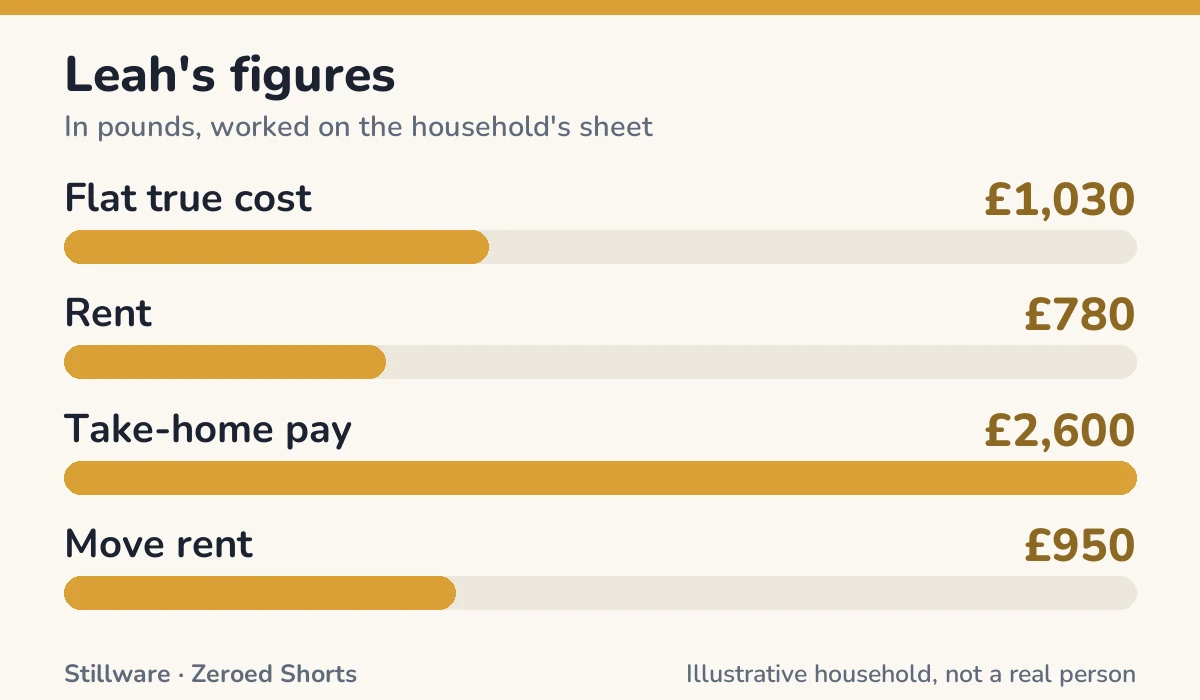
Leah says her room costs £780. Add her share of the bills and the £40 a month a home eats in loo roll and bulbs, and it is £1,030, forty percent of her take-home. She is comparing a £950 flat to £780. Rent to rent.
Leah, thirty-one, a civil servant. The households in these Shorts are illustrations built from typical UK figures, not real people, and every number below is worked on the household’s sheet.
What happened
Leah’s room costs £1,030 a month. When anyone asks, she says £780. She is thirty-one, a civil servant taking home £2,600 a month, and the difference between those two figures shapes a decision she is about to make.
Working out the real cost takes three numbers. The first is the rent, £780, which is the only one anyone ever says. It is easy to quote because it is a single fixed payment, but on its own it is not the cost of living there.
The second number is the bills that exist only because she lives in that home. Her share of those comes to £210 a month. The third is the stuff a home quietly eats: toilet roll, light bulbs, cleaning products. It comes to about £40 a month, and nobody ever counts it, because it arrives in small amounts mixed in with the weekly shop.
Added together, the three come to £1,030, not £780. That is the turn: the number she says is not the number she pays. Home costs roughly a third more than rent once the bills and the household line are counted, and only one of those three numbers ever gets spoken.
It matters now because she is looking at a flat for £950 a month, and she has been comparing that figure with £780. Rent against rent. That comparison flatters the room and makes the flat look like a bigger jump than it may be in some respects, while hiding costs in others. The honest comparison is home against home, and a flat lived in alone tends to eat more than a room in a shared house, with no one to split the bills or the cleaning cupboard with.
The method takes about three minutes. Take the rent, add a share of the bills, then find the household line on a recent statement and add that too. The total is what home actually costs. For Leah it works out at around 40 percent of what she takes home. That is a perfectly reasonable share, as long as it is the number that sits in the plan rather than the smaller one she quotes. Her rent, bills and household spending now sit as three rows under one heading called Home, so when the flat is weighed up it will be weighed against £1,030, not £780.
The working
Every figure the Short says, and where it comes from on the household’s sheet.
| The Short says | Figures | Derivation |
|---|---|---|
| one thousand and thirty / seven hundred and eighty | rent + bills + household_stuff; rent = 780 | on the sheet |
| two thousand six hundred | takehome = 2,600 | on the sheet |
| seven hundred and eighty | rent = 780 | on the sheet |
| two hundred and ten | bills = 210 | on the sheet |
| about forty a month | household_stuff = 40 | on the sheet |
| one thousand and thirty | flat_true_cost = 1,030 | flat_true_cost = rent + bills + household_stuff |
| nine fifty / seven eighty | move_rent = 950; rent = 780 | on the sheet |
| forty percent of what Leah takes home | flat_true_cost / takehome = 0.40 | on the sheet |
The turn
The figure she quotes is not the figure she pays; home costs a third more than rent once bills and the household line are counted.
The Short
Monday
- Rent, your share of the bills, the household line from your statement.
- Add them.
- Say that number.
In Zeroed
Leah’s rent, bills and household lines are three rows in one group called Home. So the flat gets weighed against one thousand and thirty, not seven eighty.
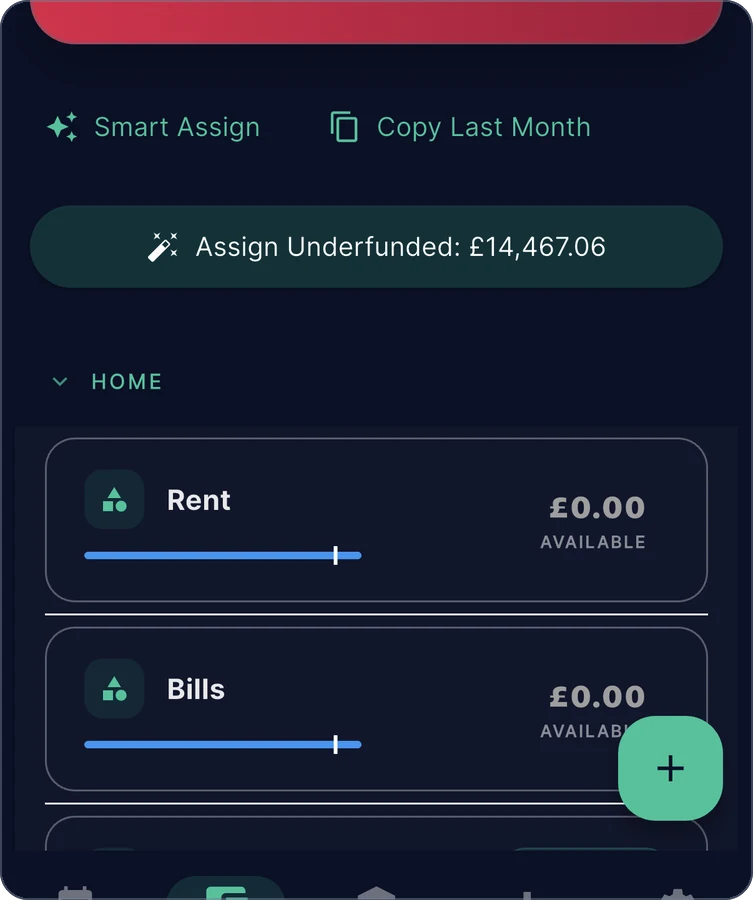
Zeroed: Offline Budget Planner is the app in the Short — envelope budgeting you buy once. It works offline, with no bank login, no subscription and no data harvesting; the first thirty-four days are free, no card needed. Try Zeroed.