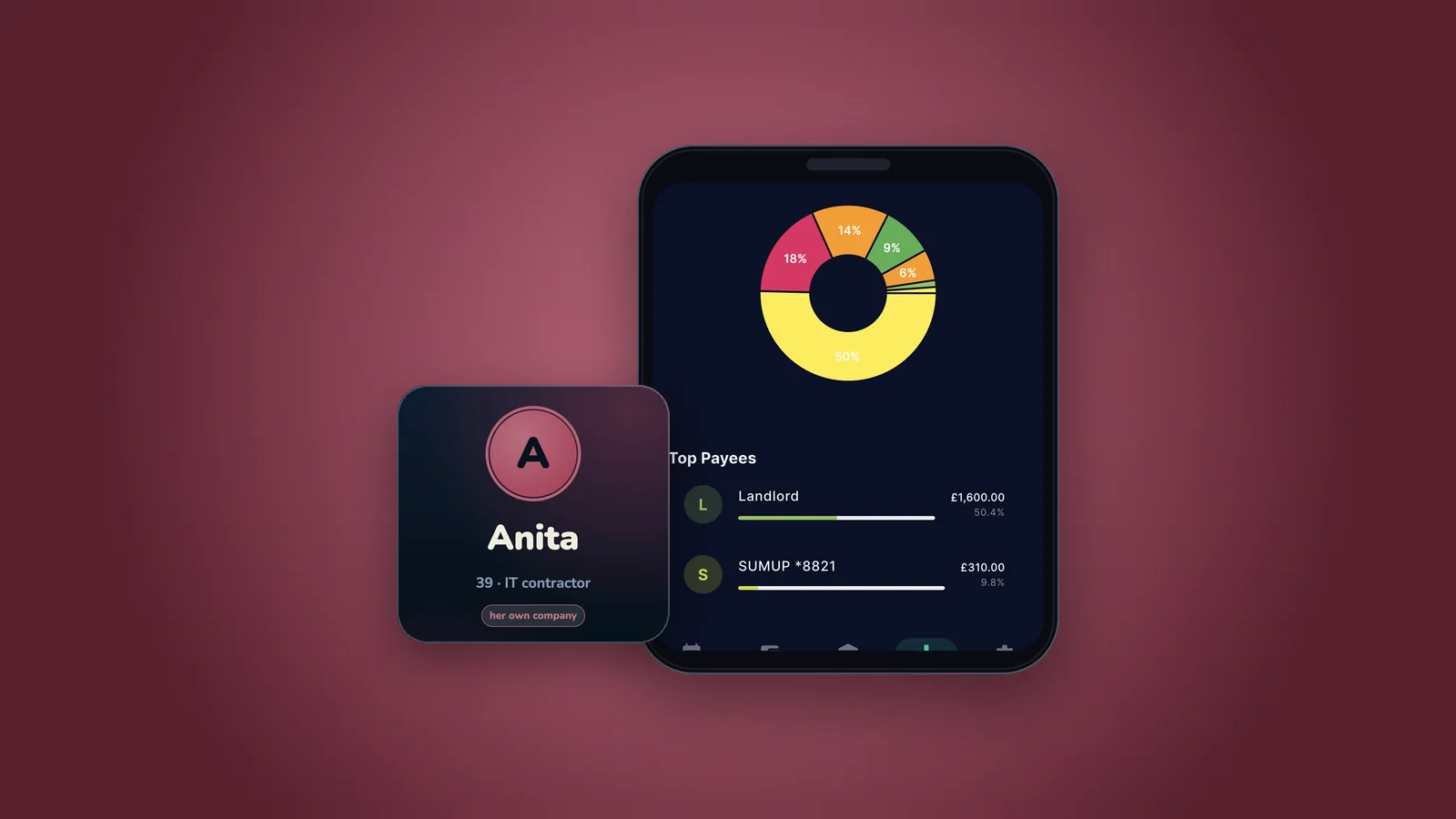
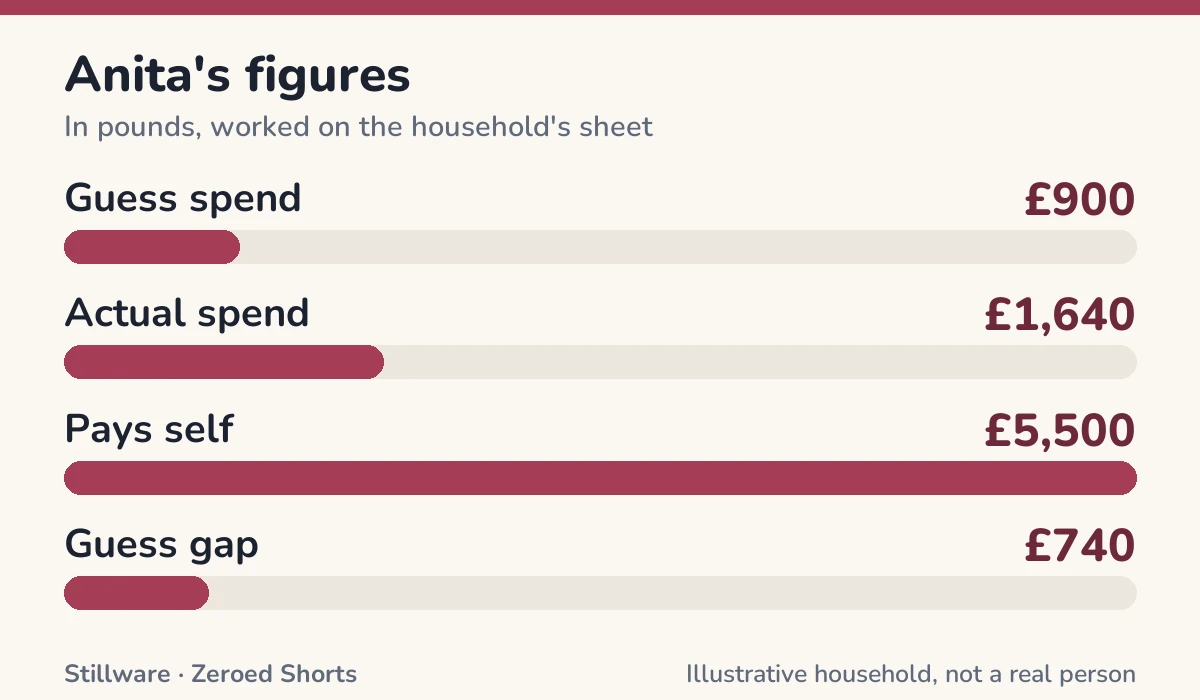
Day one, Anita guessed she spent about £900 a month on “stuff”. Day thirty, reconciled to the pound: £1,640. Not the coffees, not the takeaways — the biggest line was a payee she could not name.
Anita, thirty-nine, an IT contractor with her own company. The households in these Shorts are illustrations built from typical UK figures, not real people, and every number below is worked on the household’s sheet.
What happened
On a Sunday, Anita sat down to answer a question she thought she already knew the answer to. An IT contractor who runs her own company, she reckoned her everyday spending on general bits and pieces came to about £900 a month. To check, she took a month of statements from her personal account and gave every single line a category. The whole job took 40 minutes.
A month later, with that month fully reconciled against the bank down to the last pound, the result was in. The category she had been calling stuff did not come to £900. It came to £1,640. Her estimate had been out by £740, a far bigger miss than she would ever have expected from someone who deals with numbers for a living.
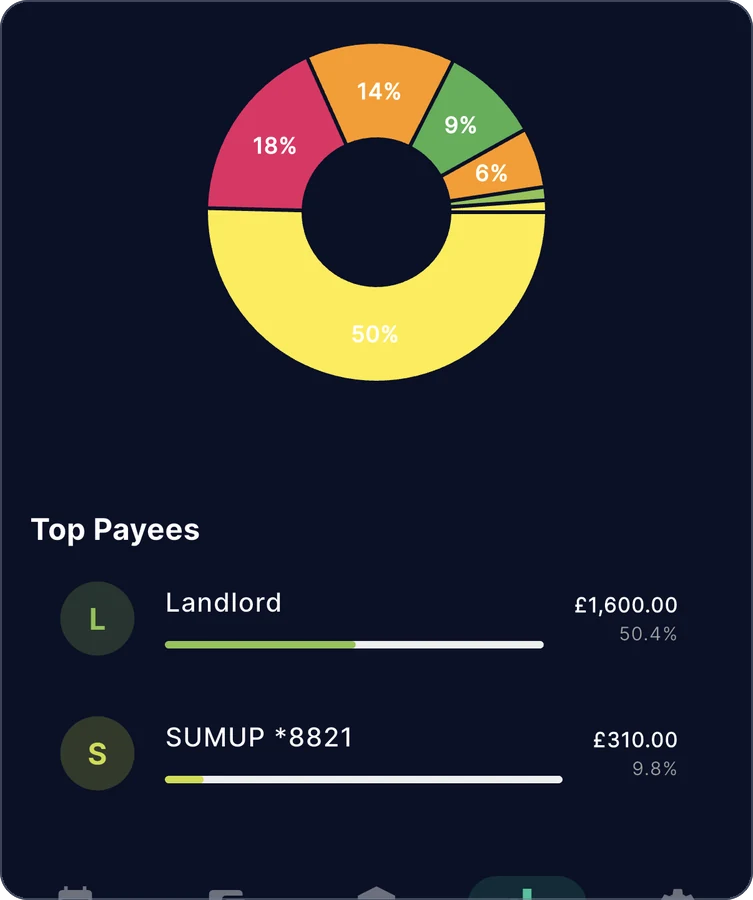
The obvious suspects turned out to be innocent. It was not the coffees, and it was not the takeaways; her sense of those had been more or less accurate. The biggest single line on the page was a payee she did not recognise at all, with £310 going to it over the month across nine small payments. On closer inspection it was the name of a card processor, appearing on the card she uses for almost everything. Behind it sat nine separate things bought online, none of them memorable, none of them feeling like real spending at the time, and together they made up the largest line on her statement.
That was the real lesson. She had assumed her guess might be a little off, give or take. In fact, it was wrong in a very particular way. It missed precisely the purchases that had never registered as spending in the first place: small, forgettable, spread across the month and hidden behind a name she had never heard of. Those were exactly the things her memory had quietly left out.
Nothing about those purchases was dramatic, and she did not need to make a grand gesture. What changed was that the line was now visible. Before, there had been nothing to decide, because as far as she knew the money had not gone anywhere. Now there was a named payee and a clear monthly total, and so there was a decision to make about it. The exercise is one anyone can repeat without handing a login to anyone: take a single month, name every line, and wait for it to reconcile. At the end sits the real figure, and very often a payee nobody remembers paying.
The working
Every figure the Short says, and where it comes from on the household’s sheet.
| The Short says | Figures | Derivation |
|---|---|---|
| nine hundred / one thousand six hundred and forty | guess_spend = 900; actual_spend = 1,640 | on the sheet |
| five and a half thousand | pays_self = 5,500 | on the sheet |
| forty minutes | import_minutes = 40 | on the sheet |
| one thousand six hundred and forty | actual_spend = 1,640 | on the sheet |
| seven hundred and forty more | actual_spend - guess_spend | on the sheet |
| three hundred and ten pounds / nine small payments | top_payee_unnamed_total = 310; top_payee_payments = 9 | on the sheet |
The turn
A guess is not wrong by a bit; it is wrong by exactly the things that never looked like spending.
The Short
Monday
- One month of statements, every line named, no login given to anyone.
- Day thirty, the real number and the payee you had never heard of.
In Zeroed
Anita’s top-payees report put a card processor first, three hundred and ten. Now it has a name, and a decision.
Zeroed: Offline Budget Planner is the app in the Short — envelope budgeting you buy once. It works offline, with no bank login, no subscription and no data harvesting; the first thirty-four days are free, no card needed. Try Zeroed.