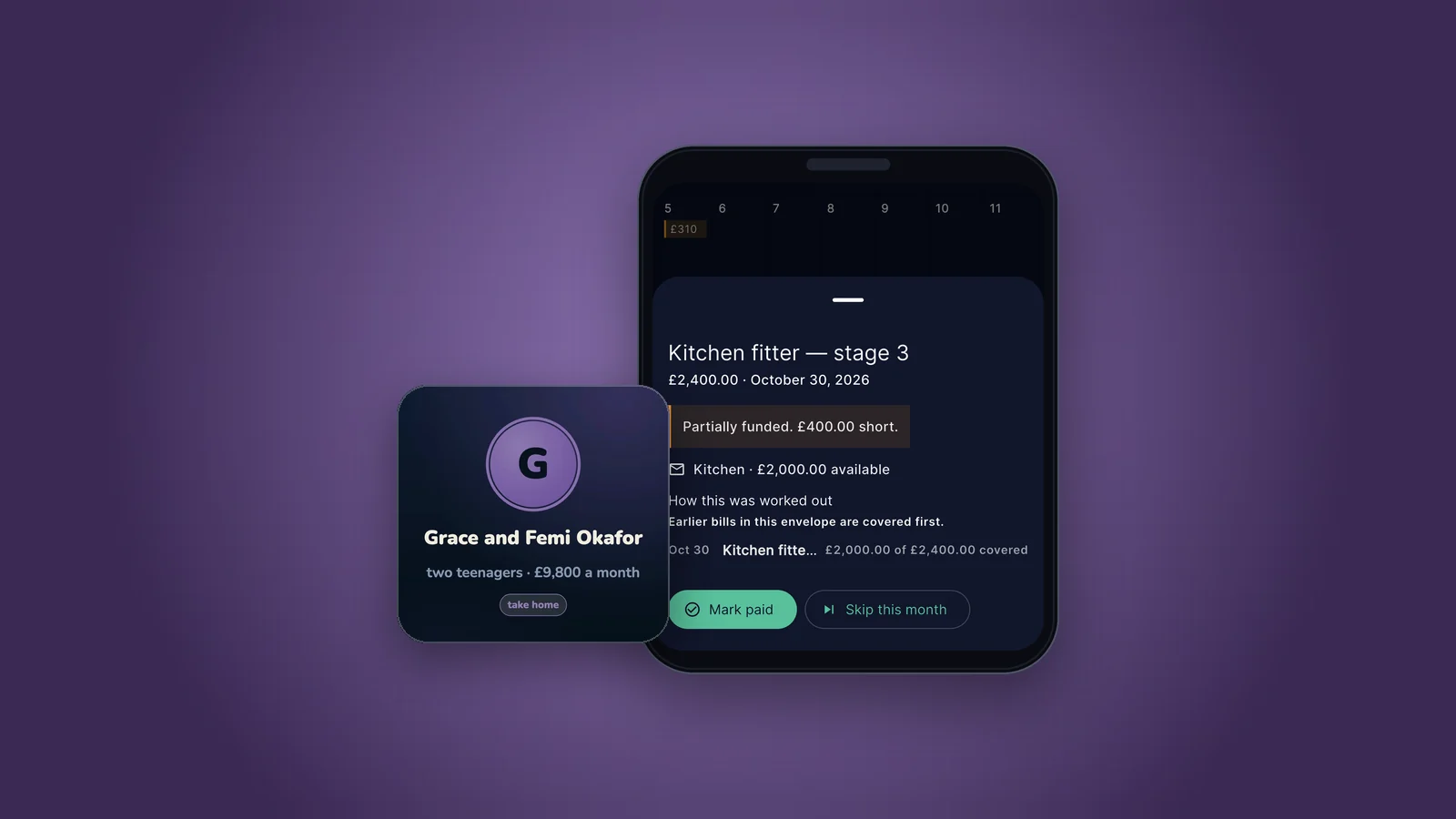
The bonus paid for the kitchen in March, £6,000, and it felt like a cash purchase. It was three stage payments, and by week eleven the tiles, the extractor and a socket had added £850. Stage three is £2,400, due on a Friday in the month with nothing spare.
Grace and Femi Okafor. The households in these Shorts are illustrations built from typical UK figures, not real people, and every number below is worked on the household’s sheet.
What happened
It is week eleven of the kitchen, and the builder wants the third stage payment by Friday. The bill says £2,400. The quote said £2,000. To see how that happened, the story has to go back to the spring.
Grace and Femi Okafor have two teenagers and take home £9,800 a month. In March, a bonus paid for the new kitchen: £6,000, set aside in one go. It felt like a cash purchase, money already in hand and the job as good as paid. It was not quite that. The builder’s terms split the £6,000 into three stage payments of £2,000 each: one at the start, one at first fix, and one at the end.
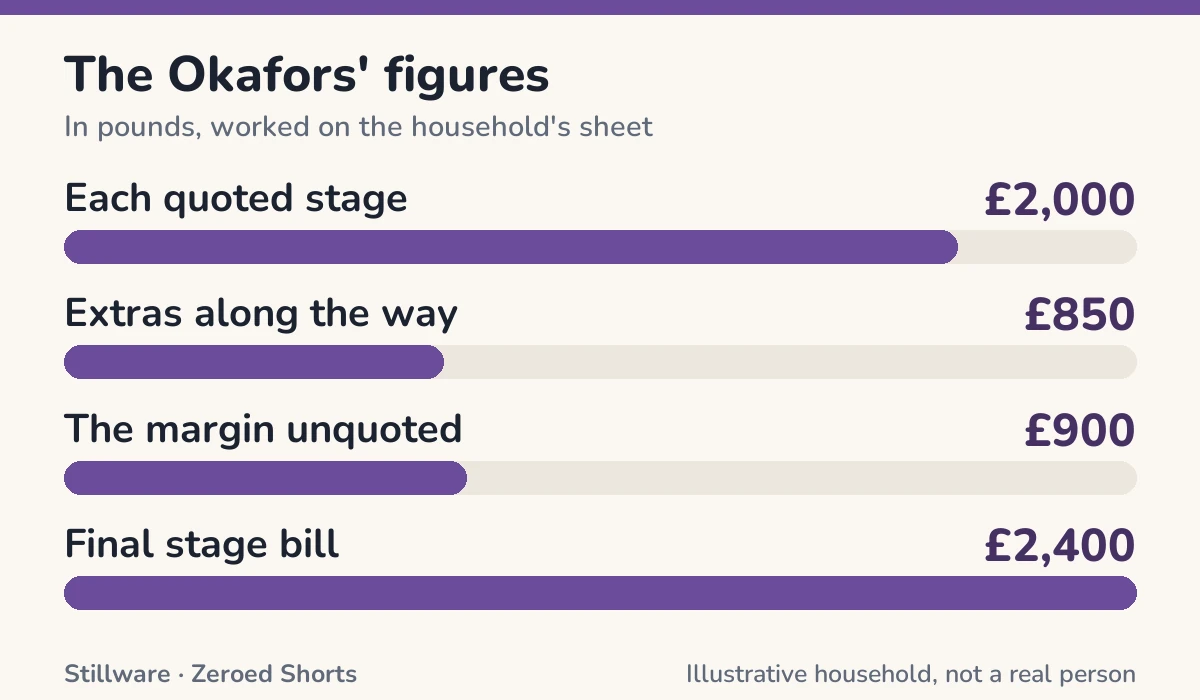
Then the job did what jobs do. In week four, the tiles the couple had chosen turned out not to be the tiles in the quote. In week seven, it was the extractor. In week nine, a socket had to move. Each change was small, and each one arrived as a sensible thing to sort while the walls were open anyway. Together they came to £850 of extras, taking the kitchen from £6,000 to £6,850. Part of that landed on the final invoice, so the third stage was no longer £2,000 but £2,400, and it fell due in the month with nothing spare.
The turn is that the budget did not break. The calendar did. The money was set aside in March as one number, but the bill arrived in three parts spread over the weeks, and the last one was the biggest. Every project carries a margin of around fifteen per cent that nobody quotes. On this kitchen that was £900, enough to cover the £850 of extras. Had it been added to the quote before a single wall came down, each extra would have been a transfer from an envelope rather than an argument at the kitchen table.
The second change is about dates. Put on the calendar, each stage payment has a day attached, and the last one stops being a surprise in the month the household can least afford one. For the next project, the Okafors’ approach is set: the quote plus fifteen per cent goes into an envelope, the stages are written down with their dates, and the biggest payment is funded first, so that the £2,400 is visible long before the Friday it is due.
The working
Every figure the Short says, and where it comes from on the household’s sheet.
| The Short says | Figures | Derivation |
|---|---|---|
| two thousand four hundred / two thousand | kitchen_stage3 = 2,400; kitchen_stage = 2,000 | kitchen_stage3 = kitchen_stage + 400 of extras billed at stage three; kitchen_stage = kitchen_quote / 3 |
| nine thousand eight hundred | takehome = 9,800 | on the sheet |
| six thousand | kitchen_quote = 6,000 | kitchen_quote = bonus_kitchen |
| two thousand at the start, the same at first fix, the same at the end | kitchen_quote / 3 | on the sheet |
| eight hundred and fifty of extras | kitchen_extras = 850 | on the sheet |
| two thousand four hundred, in the month with nothing spare | kitchen_stage3 = 2,400 | kitchen_stage3 = kitchen_stage + 400 of extras billed at stage three |
The turn
What breaks is not the budget but the calendar — the money was set aside in March as one number, and the bill arrives in three, the last one bigger.
The Short
Monday
- The quote plus fifteen percent in an envelope.
- The stages, dated.
- The biggest one funded first.
In Zeroed
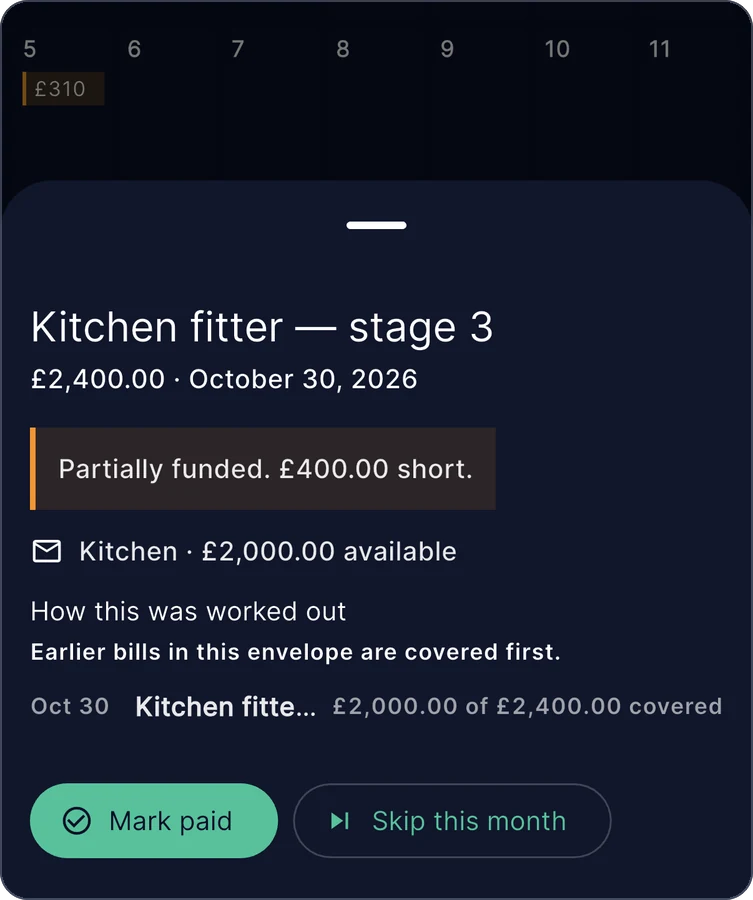
the Okafors’ kitchen stages sit on the bills calendar on their dates. So stage three’s two thousand four hundred is seen in March, not on the Friday it is due.
Zeroed: Offline Budget Planner is the app in the Short — envelope budgeting you buy once. It works offline, with no bank login, no subscription and no data harvesting; the first thirty-four days are free, no card needed. Try Zeroed.