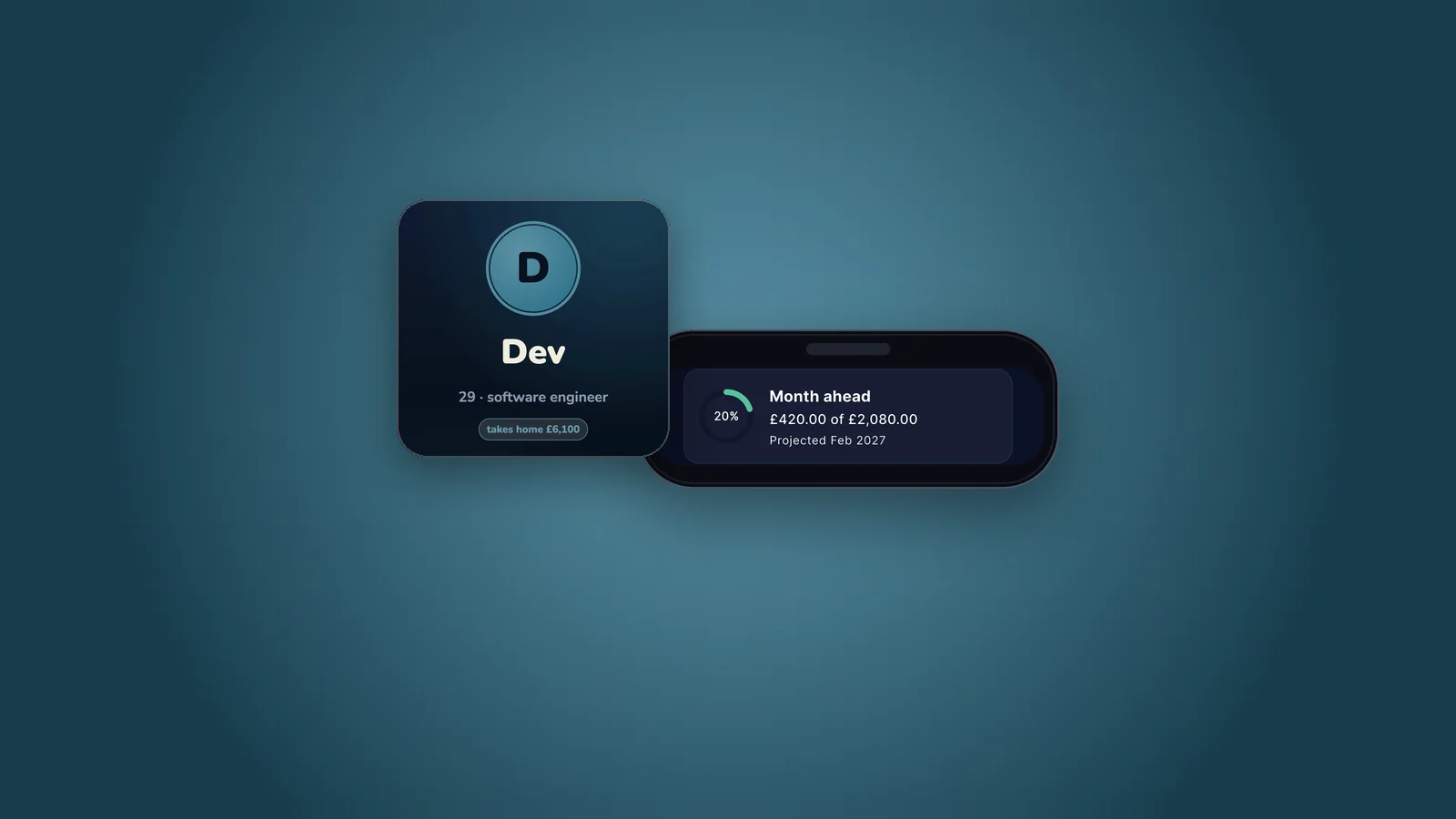
Day one, Dev divided his take-home by what he saves and got fifteen months, and closed the spreadsheet. Day thirty, someone told him a month ahead is a month of the bills that do not move: £2,080, five months, March.
Dev, twenty-nine, software engineer. The households in these Shorts are illustrations built from typical UK figures, not real people, and every number below is worked on the household’s sheet.
What happened
On day one, Dev decided he wanted to get a month ahead, so that each month’s bills would be paid from money that had already arrived. He is twenty-nine, a software engineer, and he takes home £6,100 a month. He sat down with a spreadsheet and did the sum that seemed obvious. He took his take-home pay and divided it by what he manages to save each month, which is £420. The answer was fifteen months. He closed the spreadsheet, because more than a year felt like the kind of goal that quietly gets abandoned.
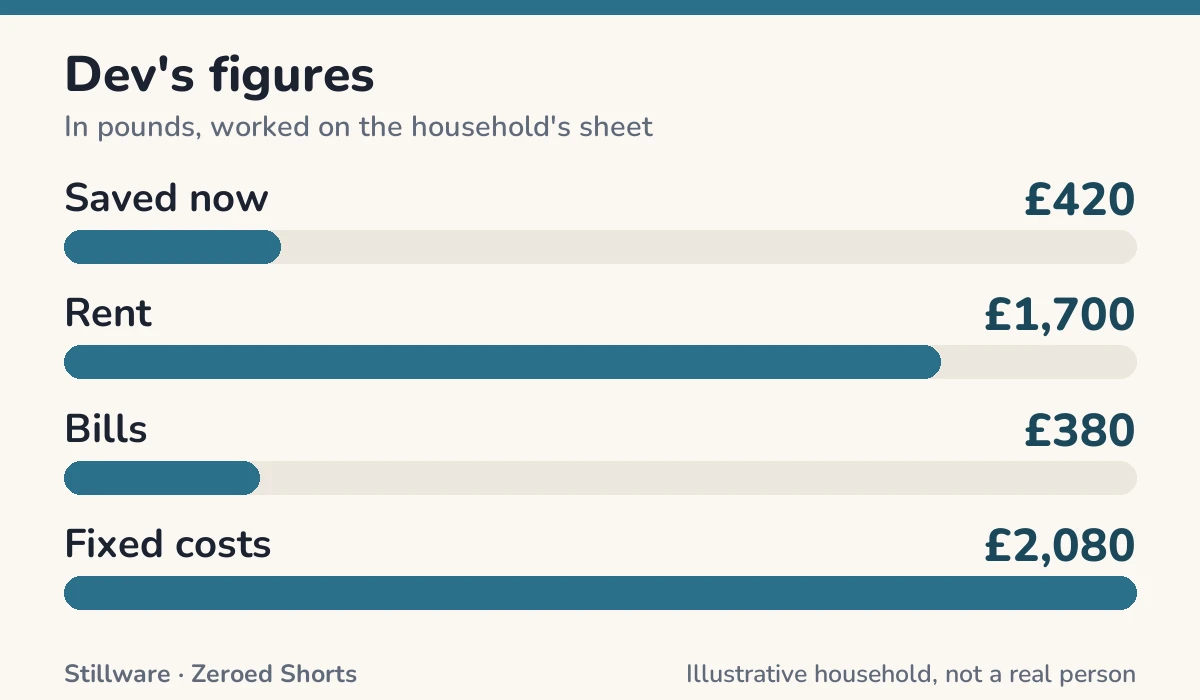
On day thirty, someone told him the thing nobody tends to say out loud. A month ahead is not a month of income. It is a month of the bills that do not move. For Dev that meant two lines. Rent is £1,700 a month. Bills are £380. Together they come to £2,080, and nothing more is needed. The groceries, the evenings out and the rest of the spending still come out of each month’s pay as normal; what needs to be sitting there in advance is only the money that has to leave on a fixed date.
At £420 a month, £2,080 takes five months to save. Starting in October, the goal is full by the end of February, and Dev is a month ahead from March. Nothing about his income or his saving had changed between day one and day thirty. That is the turn. The number did not move; the question did. How much he earned had become how much had to leave, and the second question has a much smaller answer.
There was a shortcut available too. A single share vest of £4,000 would cover nearly two months of fixed costs in one step. But the shortcut is not really the point. The point is that the goal now has a date on the calendar instead of sitting under the heading of someday.
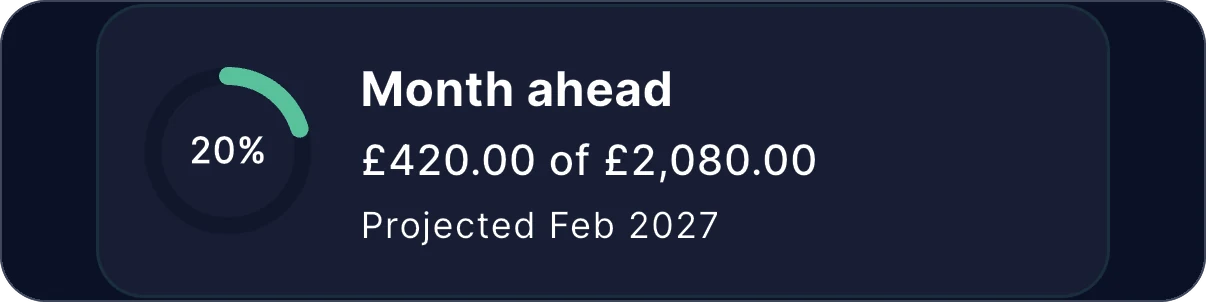
What a month ahead buys is easy to describe. On the first of each month, next month’s rent and bills are already there. Payday stops being a deadline and becomes simply the day money arrives. The plan itself fits on three lines: fixed costs on one, saving on another, and the division between them. Then the month goes in the calendar. Dev’s goal already holds his first £420 and points to February, so from March the rent no longer waits on payday.
The working
Every figure the Short says, and where it comes from on the household’s sheet.
| The Short says | Figures | Derivation |
|---|---|---|
| fifteen months / five | ceil(takehome_now / saved_now); ceil(fixed_costs / saved_now) | on the sheet |
| six thousand one hundred | takehome_now = 6,100 | on the sheet |
| six thousand one hundred / four hundred and twenty | takehome_now = 6,100; saved_now = 420 | on the sheet |
| fifteen months | income_route_months = 15 | income_route_months = ceil(takehome_now / saved_now) |
| seventeen hundred / three hundred and eighty | rent = 1,700; bills = 380 | on the sheet |
| two thousand and eighty | rent + bills | on the sheet |
| four hundred and twenty a month / five months / March | saved_now = 420; ceil(fixed_costs / saved_now); month_ahead_month | on the sheet |
| one vest, four thousand, is nearly two months of fixed costs | rsu_vest / fixed_costs = 1.9 | on the sheet |
| his first four hundred and twenty / projects February | saved_now = 420; month_ahead_full | on the sheet |
The turn
The number did not change between day one and day thirty; the question did — “how much do I earn” became “how much has to leave.
The Short
Monday
- Fixed costs on a line, saving on a line, divide.
- Put the month in the calendar.
In Zeroed
Dev’s Month ahead goal holds his first four hundred and twenty and projects February. So from March, rent day never waits on payday.
Zeroed: Offline Budget Planner is the app in the Short — envelope budgeting you buy once. It works offline, with no bank login, no subscription and no data harvesting; the first thirty-four days are free, no card needed. Try Zeroed.