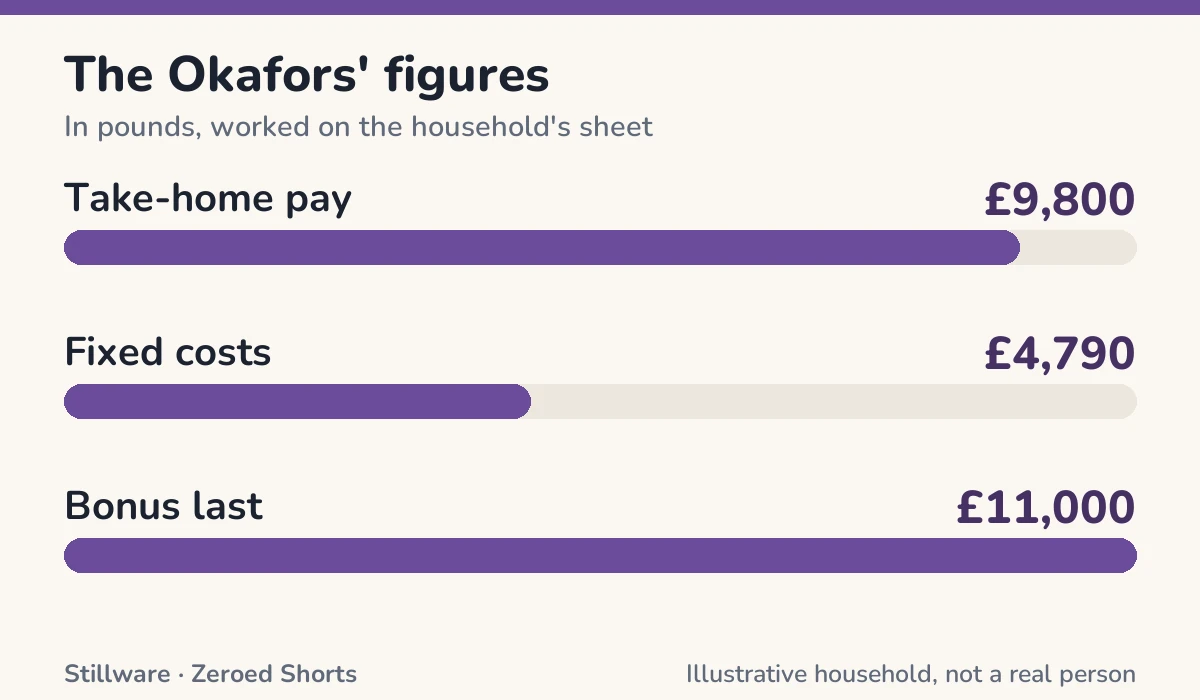
Everyone says “get a month ahead” and nobody says what it costs, so it sounds like a month of income. It is a month of the costs that do not move: £4,790 for the Okafors, once. Their March bonus was £11,000.
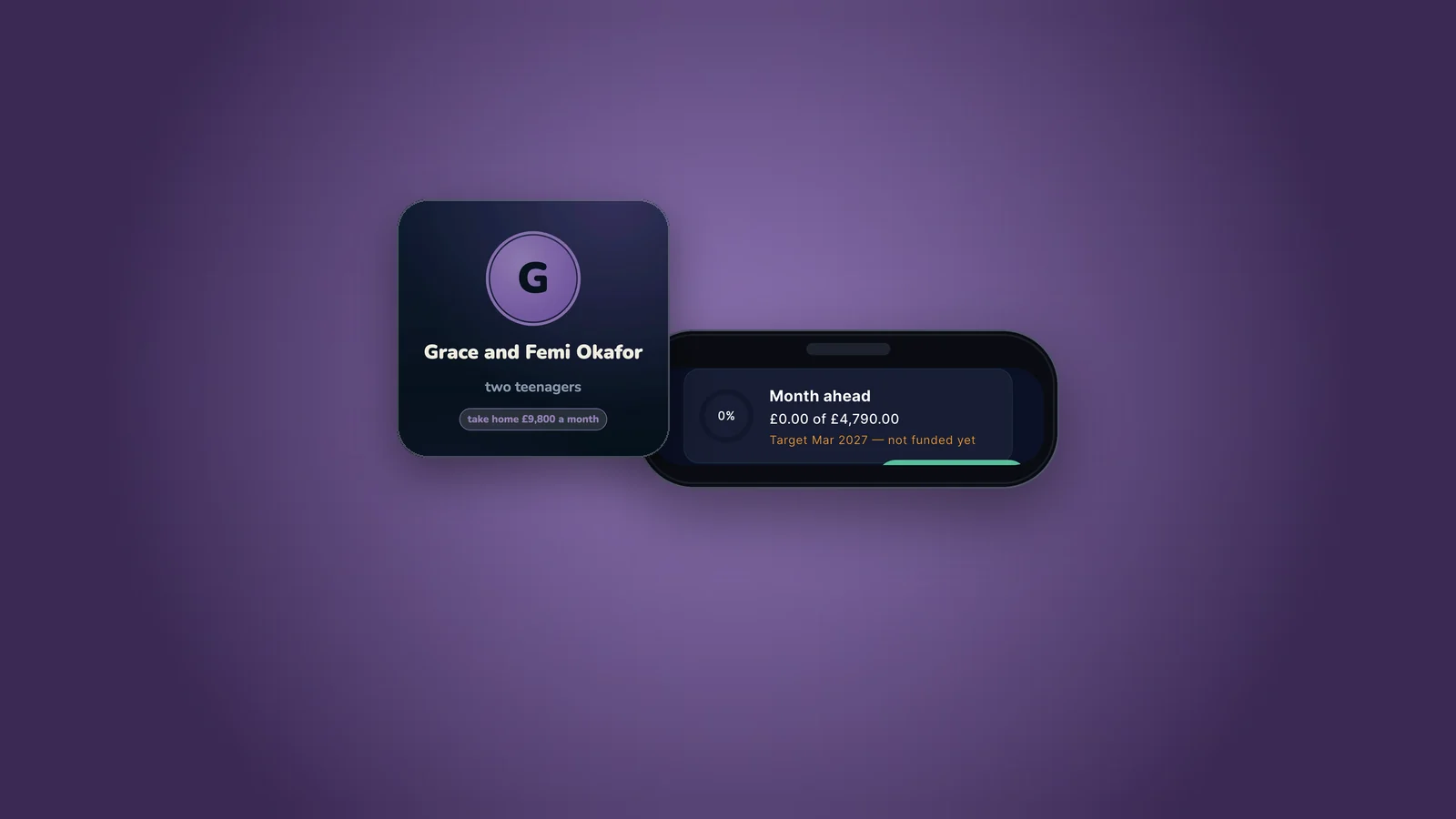
Grace and Femi Okafor. The households in these Shorts are illustrations built from typical UK figures, not real people, and every number below is worked on the household’s sheet.
What happened
Grace and Femi Okafor have two teenagers and take home £9,800 a month between them. Like most households, they had heard the advice to get a month ahead, so that each month’s bills are paid from money that arrived the month before. Nobody ever said what that would cost, and so it sounded enormous. If a month ahead meant a month of income, the price was £9,800, and that felt like the work of a year.
It was not a month of income. Getting a month ahead means holding one month of the costs that do not move: the mortgage, the household bills, food, the two cars, and the money they send to support Grace’s mother. Added together, those came to £4,790. That was the whole price, and it was a price paid once, not every month.
Set beside that figure was something they already received. The March bonus last year was £11,000. The month ahead they had been treating as a distant goal was smaller than half of a single bonus. That was the turn: they had been handed a month ahead, twice over, every March, and had spent it. Last year it went on a kitchen. The money had been there all along; it had simply never been pointed at the job.
The fix took two numbers. The first was the fixed costs, written on one line, because that is what a month ahead actually costs. Not income, and not a round figure that sounds safe, but the specific costs that arrive whatever happens. For the Okafors that line read £4,790. The second number was the next lump due to arrive. For them it is the March bonus, but the same logic applies to a share vest, a tax refund or anything else that lands irregularly. Whatever arrives next pays the month ahead first, before anything else gets a claim on it.
So their month ahead goal now reads £4,790, due by March, when the next bonus lands. When it does, the first slice moves straight into next month, and the bills for April are paid from money already sitting there. After that, the bonus can still buy things; it simply buys the month ahead before it buys anything else. A target that had felt like a year of discipline turned out to be one decision, made once, about money that was already on its way.
The working
Every figure the Short says, and where it comes from on the household’s sheet.
| The Short says | Figures | Derivation |
|---|---|---|
| less than half of one bonus | fixed_costs / bonus_last = 0.44 | on the sheet |
| nine thousand eight hundred | takehome = 9,800 | on the sheet |
| nine thousand eight hundred | takehome = 9,800 | on the sheet |
| four thousand seven hundred and ninety | mortgage + bills + groceries + cars + parent_support | on the sheet |
| eleven thousand | bonus_last = 11,000 | on the sheet |
| a month ahead, twice over | bonus_last > 2 * fixed_costs | on the sheet |
| four thousand seven hundred and ninety / by March, when the next bonus lands | fixed_costs = 4,790; bonus_next_month | fixed_costs = mortgage + bills + groceries + cars + parent_support |
The turn
A month ahead” sounds like a month of income; it is a month of the costs that do not move, and the bonus alone is more than two of them.
The Short
Monday
- Fixed costs on one line, that is the price.
- The next lump pays it, into next month, before anything else.
In Zeroed
the Okafors’ Month ahead goal reads four thousand seven hundred and ninety, by March, when the next bonus lands. So that bonus buys a month ahead before it buys anything else.

Zeroed: Offline Budget Planner is the app in the Short — envelope budgeting you buy once. It works offline, with no bank login, no subscription and no data harvesting; the first thirty-four days are free, no card needed. Try Zeroed.