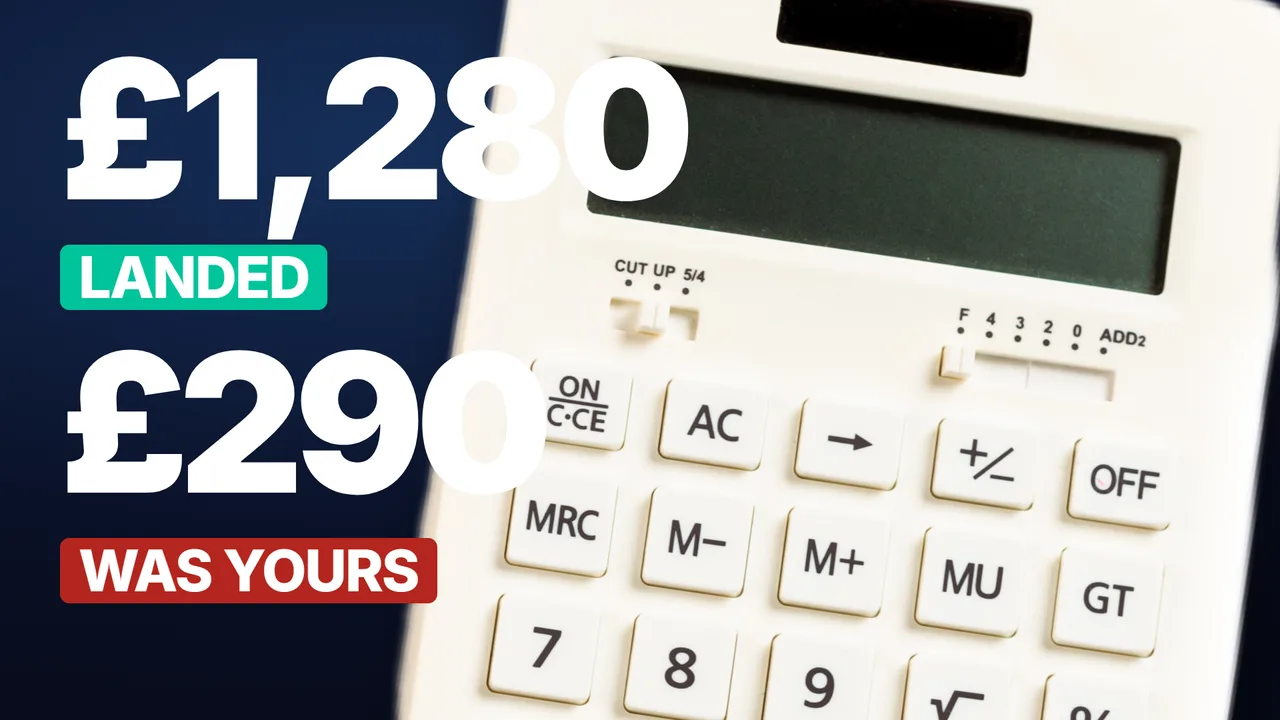
If you are paid monthly, the whole budget is one subtraction on payday: take everything with a date on it between now and the next payday — rent, council tax, energy, water, phone, and the dated one-offs — and take it off the money that just landed. What is left is what the month is actually worth. Divide that by the weeks until you are paid again, and that weekly figure, not your balance, is the number to spend from. On the household below, £1,280 lands and only £290 of it is ever available: £72.50 a week.
Why week three is the week it goes wrong
Nothing dramatic happens in week three. No one overspends. What happens is that the bills have finished leaving and the spending has not, and the account never told anyone the difference.
Here is the household. One salary, £1,280 take-home, paid on the first.
| What | Amount | When |
|---|---|---|
| Take-home | £1,280.00 | the 1st |
| Rent | £620.00 | the 1st |
| Council tax | £105.00 | the 1st |
| Energy | £95.00 | early |
| Water | £32.00 | early |
| Phone | £38.00 | mid-month |
| School lunches | £30.00 | dated |
| Car insurance | £35.00 | dated |
| Birthday | £35.00 | dated |
| Promised, total | £990.00 | |
| Left for the whole month | £290.00 | |
| Per week (÷ 4) | £72.50 |
That £990 is in the account on payday. It is not available. Those are two different things, and a banking app only ever shows you one of them.
The arithmetic of the crash
Stop halfway through the month and count what has gone.
By the fifteenth, the bills have taken £890. Everyday spending — groceries and travel, at exactly the pace the plan asked for — has taken about £162.50 more. The balance reads £227.50, which feels survivable.
It is not, because £100 of it is still owed: the school lunches, the car insurance and the birthday have not been paid yet. Take those off and the genuinely free money for the back half of the month is £127.50, spread over fifteen days. That is £8.50 a day, against a plan built for £10.83 a day.
Every number in that paragraph is the plan working. Nobody went off-budget. The month simply ran out of the part that was ever theirs, while the balance still read positive.
The £35 that was there on day one
Add up what this household actually plans to spend week to week — groceries £240 and travel £85 — and it comes to £325. The month can only give it £290.
The difference is £35, and it is not a week-three surprise. It exists on payday, before a single purchase, and you can see it the moment you do the subtraction. Meeting it on the first is the difference between choosing what gives and finding out at a till on the seventeenth.
The method, on paper
It takes about ten minutes and it works on paper, in a spreadsheet, or in any envelope app.
- Write down what actually landed. Not your salary, not your usual — the figure in the account on payday.
- List everything with a date on it between now and the next payday, and what it costs. Rent, council tax, energy, water, phone, broadband, subscriptions you have not cancelled, and the dated one-offs — the MOT, the birthday, the school trip.
- Add them up. That total is promised money.
- Subtract it. What is left is what the month is worth.
- Divide by the weeks until the next payday. That is the number to hold.
- If the answer is negative, you have just found week three on day one. Cut something before the month starts rather than discovering it at a card machine.
What the usual advice gets right — and what it leaves out
Search this question and you will be told, correctly, to use a zero-based budget, to move your direct debits to the day after payday, to keep separate accounts or pots, and to build sinking funds for annual costs. All four are good, and none of them is the thing that breaks.
What is almost always missing is the worked month that does not balance. Every budget template assumes the sums come out. This one does not: it is £35 short, and knowing that on the first is the entire value of doing the subtraction.
The pots advice is worth a sentence of its own. Splitting money across accounts or pots is a fine way to hold the answer, but it is not the answer — you still have to decide what goes in each one, and that decision is this subtraction. Pots divide the money; they do not divide the plan.
Doing it in Zeroed
I built Zeroed for exactly this month.
You give each envelope its amount on payday, and the header at the top of the budget shows what is left to assign. On this household it reads −£35.00 on the first — before anything is spent — which is the whole point: the shortfall arrives as a number on payday instead of as a declined card in week three. The two envelopes that actually get spent week to week, groceries and travel, are the only ones the weekly figure has to cover; everything else is dated and already counted.
One payment, no subscription, works offline, and it never asks for your bank login. The method above works without it — the arithmetic is what matters, not where you keep it. The zero-based budget calculator does the same subtraction on your own figures, free, in the browser.
If the gap is bigger than £35
If the subtraction comes out badly negative, or if the rent and council tax are already behind, this is not a budgeting problem to solve with a spreadsheet. Ring StepChange or Citizens Advice before anything else. Both are free.
FAQ
Do I divide by four weeks or by the number of days? Either, as long as you are consistent. Weeks are easier to hold in your head; days are more accurate in a 30- or 31-day gap. This household’s £290 is £72.50 a week or about £9.60 a day.
What if my payday moves for a bank holiday? The money arrives earlier, the bills still leave on their own dates, and the gap to the next payday gets longer. Do the subtraction on the money that landed and divide by the weeks to the next payday, not by four out of habit.
What about a five-week month? Same subtraction, then divide by five instead of four. The weekly figure drops, which is the honest answer — a longer month does not come with more money.
Should I do this before or after moving money into savings? Treat savings as a dated thing and put it in the £990. If it only survives as “whatever is left”, it will not survive week three.
Is this the same as zero-based budgeting? It is the first half of it. Zero-based budgeting gives every pound a job; this is the subtraction that tells you how many pounds you actually have to give jobs to.
This is education about a budgeting method, not financial advice. The figures above are a worked example on one household, not a recommendation.
Watch next: Sinking Funds UK: The Total Nobody Says Out Loud — the same household, and what four ordinary sinking funds add up to.