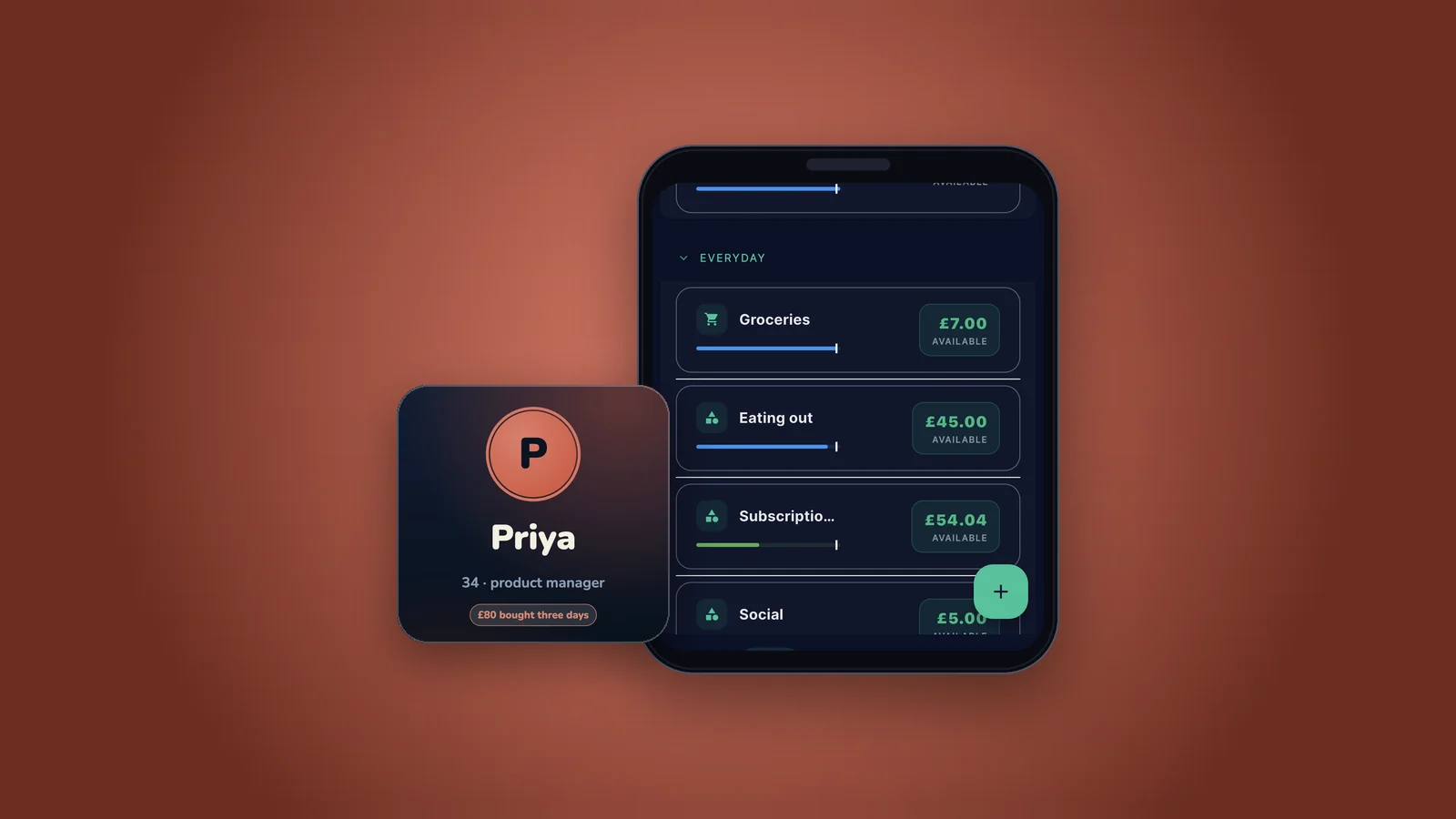
Priya gave her eating-out budget £80 more a month and the money ran out three days later than before: the 23rd instead of the 20th. The ten days after were going on a card, £210 a month, £2,520 a year the budget never saw. Cutting the same money into weeks fixed it.
Priya, thirty-four, product manager. The households in these Shorts are illustrations built from typical UK figures, not real people, and every number below is worked on the household’s sheet.
What happened
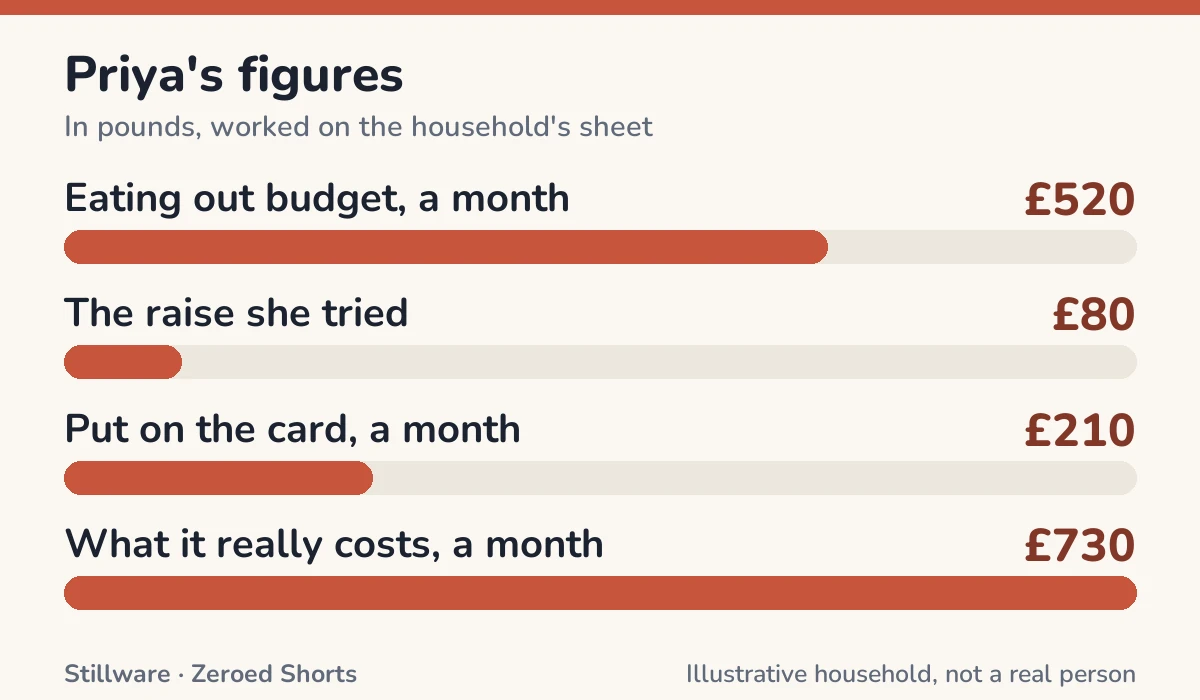
Priya tried the obvious fix first. Her eating-out money kept running out before the month did, so she gave it £80 more. The result was underwhelming: instead of running dry on the 20th, it ran dry on the 23rd. For £80 a month she had bought herself three extra days, and she wanted to know why the money had done so little.
She is thirty-four and works as a product manager, and the numbers, once laid out, were plain. Her eating-out budget was £520 a month, and it was gone by the 20th. The ten days that followed went on a credit card, at roughly £210 each month. So what she actually spent on eating out was £730, a figure she had never once seen, because it lived in two separate places: part in her budget, part on the card statement. Over a year, the card half alone came to £2,520, all of it spent after the money meant for eating out had already run out.
The assumption had been that the category was simply underfunded, and that more money would push the date back far enough to stop the card taking over. It did not, because money had never been the problem. The problem was the length of the container. A month is too long for anyone to feel. On the third the budget looks full, on the twelfth it still looks fine, and then the 20th arrives as if from nowhere, like a change in the weather. Topping up a month-long pot only moved the cliff a few days along.
So she kept the same money and changed its shape. The monthly amount was cut into weeks of £120 each, resetting every Friday. The difference is in what a bad stretch costs. If a week runs empty, the gap until the next reset is a few days, perhaps four on the card at worst. When a whole month ran empty, the gap was ten. Two Fridays into the new arrangement, she was £9 under her weekly amount, and the card had nothing on it at all.
The measure that matters, for anyone who recognises the pattern, is the date the spending money runs out. If that date is predictable, the answer is to divide that category’s money into weeks rather than give it more. Priya now checks her eating-out pace once a week, on Friday, and since the switch the card has stayed empty.
The working
Every figure the Short says, and where it comes from on the household’s sheet.
| The Short says | Figures | Derivation |
|---|---|---|
| eighty pounds more / three days later / the twenty-third, not the twentieth | eating_out_tried - eating_out_budget; eating_out_tried_day - eating_out_runs_out_day; eating_out_tried_day = 23; eating_out_runs_out_day = 20 | on the sheet |
| eighty pounds bought her three days | eating_out_raise = 80; tried_days_later = 3 | eating_out_raise = eating_out_tried - eating_out_budget; tried_days_later = eating_out_tried_day - eating_out_runs_out_day |
| five hundred and twenty / the ten days after / about two hundred and ten | eating_out_budget = 520; days_on_card = 10; eating_out_card_overflow = 210 | days_on_card = 30 - eating_out_runs_out_day |
| seven hundred and thirty | eating_out_budget + eating_out_card_overflow | on the sheet |
| two thousand five hundred and twenty pounds | eating_out_card_overflow * 12 | on the sheet |
| one hundred and twenty a week | weekly_envelope = 120 | weekly_envelope = round(eating_out_budget / 4.33, -1) |
| nine pounds under | week_under = 9 | on the sheet |
The turn
More money did not move the date, because a month is too long a container for a person to feel; the same money cut into weeks did.
The Short
Monday
- Find the date your spending money runs out.
- If you can predict it, divide that category’s money into weeks.
In Zeroed
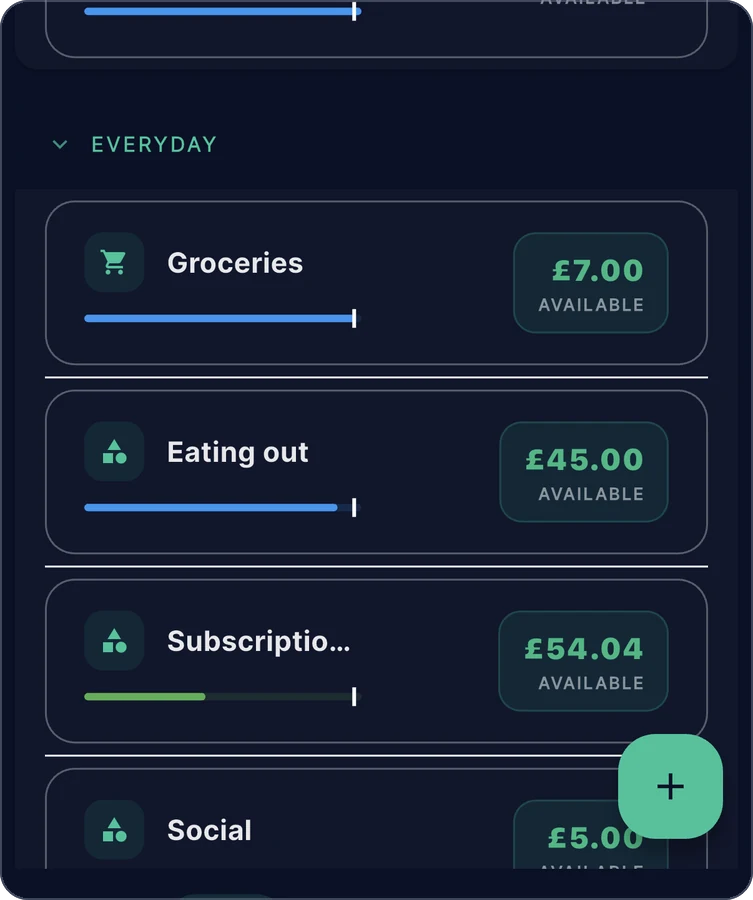
Priya’s Eating out row shows a pace mark. She checks it each Friday, and the card has stayed empty.
Zeroed: Offline Budget Planner is the app in the Short — envelope budgeting you buy once. It works offline, with no bank login, no subscription and no data harvesting; the first thirty-four days are free, no card needed. Try Zeroed.