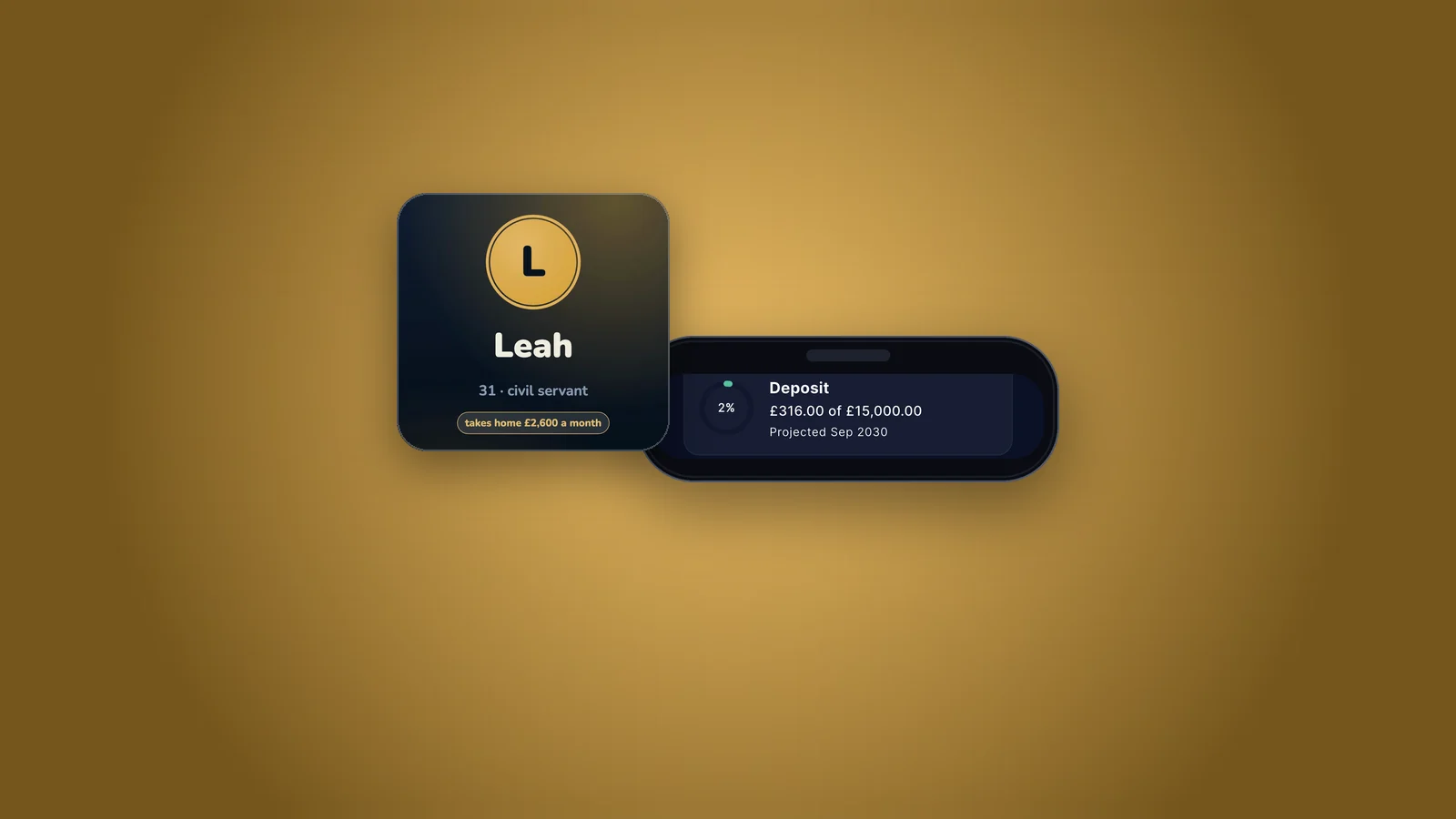
Leah has wanted a £15,000 deposit for three years, with nothing in it. What is genuinely left each month, after the surprises envelope, is £316. Fifteen thousand divided by that is forty-eight months. “Eventually” is September 2030, and now it can be argued with.
Leah, thirty-one, a civil servant. The households in these Shorts are illustrations built from typical UK figures, not real people, and every number below is worked on the household’s sheet.
What happened
At a family dinner, someone asks Leah the question she has heard before: so when are you buying? Her answer, as usual, is eventually. Leah is thirty-one, works as a civil servant and takes home £2,600 a month. She wants £15,000 for a deposit on a home of her own. That has been the wish for three years, and in all that time nothing has gone into it.
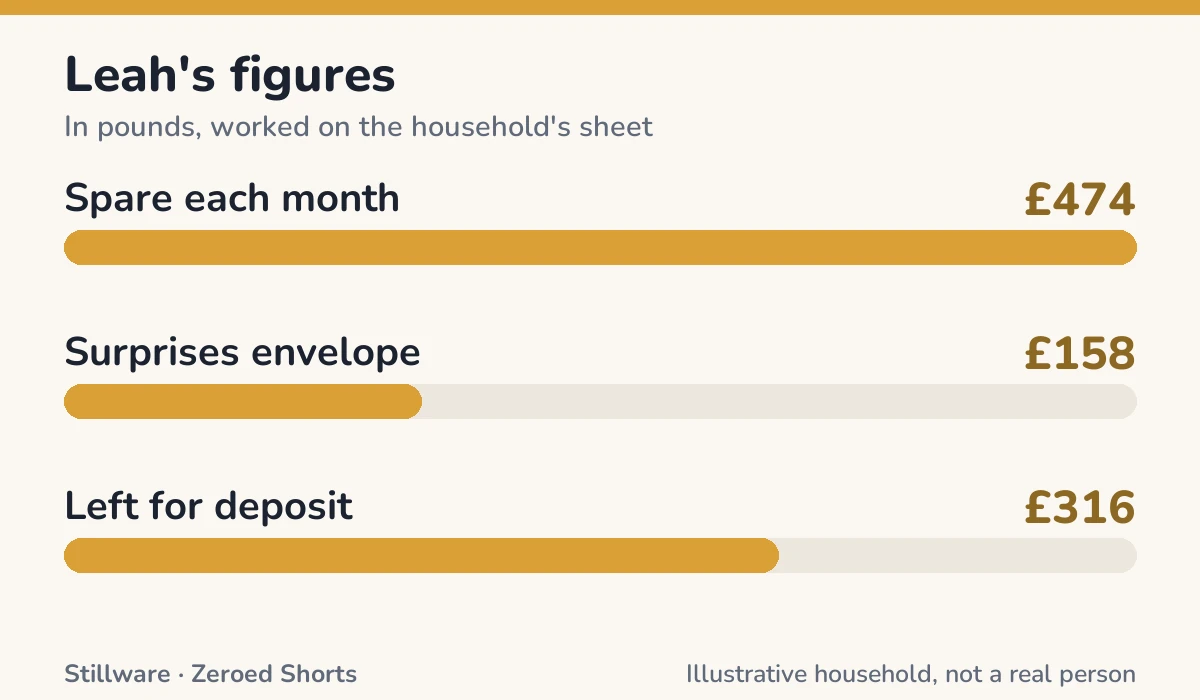
The working starts with what is genuinely left each month, not what seems to be left. After her regular costs, Leah has £474 spare. But not all of that is free. A surprises envelope of £158 a month has to come out first, because the unexpected bill always arrives and it is not optional. That leaves £316 a month that could honestly go towards a deposit.
Divide £15,000 by £316 and the answer is 48 months. Four years. Counted forward from now, that lands in September, twenty-thirty. It is not a thrilling answer, but it is a real one, and for the first time the deposit has a finishing line rather than a vague direction.
The turn is in what the word eventually was doing all along. It is not a plan, and it is not quite a wish either. It is a way of never finding out which of the two it is. Four years, by contrast, is a plan: it has a date and a monthly number that can be said out loud at dinner. And if four years feels too long, that is useful information too. The wish then becomes a decision with three honest options: earn more, want less, or wait. Whichever is chosen, it is chosen rather than drifted into.
So the answer at the next dinner is different. Leah can say twenty-thirty, at £316 a month, and invite the question again in a year to see whether it is still twenty-thirty. The method behind it works for any large goal: take the target, divide it by what is left after the dated envelopes have been paid, and the result is a month and a year. Saying it out loud once is the real test of whether it feels like a plan worth keeping or a wish worth changing.
The working
Every figure the Short says, and where it comes from on the household’s sheet.
| The Short says | Figures | Derivation |
|---|---|---|
| four years | deposit_months / 12 | on the sheet |
| two thousand six hundred | takehome = 2,600 | on the sheet |
| fifteen thousand / three years | deposit_wish = 15,000; wish_years = 3 | on the sheet |
| four hundred and seventy-four / one hundred and fifty-eight | spare = 474; surprises_monthly = 158 | spare = takehome - committed |
| three hundred and sixteen / forty-eight months | spare - surprises_monthly; ceil(deposit_wish / 316) | on the sheet |
| September twenty-thirty | 48 monthly payments from October 2026: the 48th is September 2030 | on the sheet |
| twenty-thirty, at three hundred and sixteen a month | deposit_monthly_possible = 316 | deposit_monthly_possible = spare - surprises_monthly |
The turn
“eventually” is not a plan and not a wish; it is a way of not finding out which.
The Short
Monday
- The target, divided by what is left after your dated envelopes.
- The answer is a month and a year.
- Say it out loud once.
In Zeroed
Leah’s Deposit goal takes three hundred and sixteen a month toward its target. So “eventually” became a date she can say at dinner.

Zeroed: Offline Budget Planner is the app in the Short — envelope budgeting you buy once. It works offline, with no bank login, no subscription and no data harvesting; the first thirty-four days are free, no card needed. Try Zeroed.