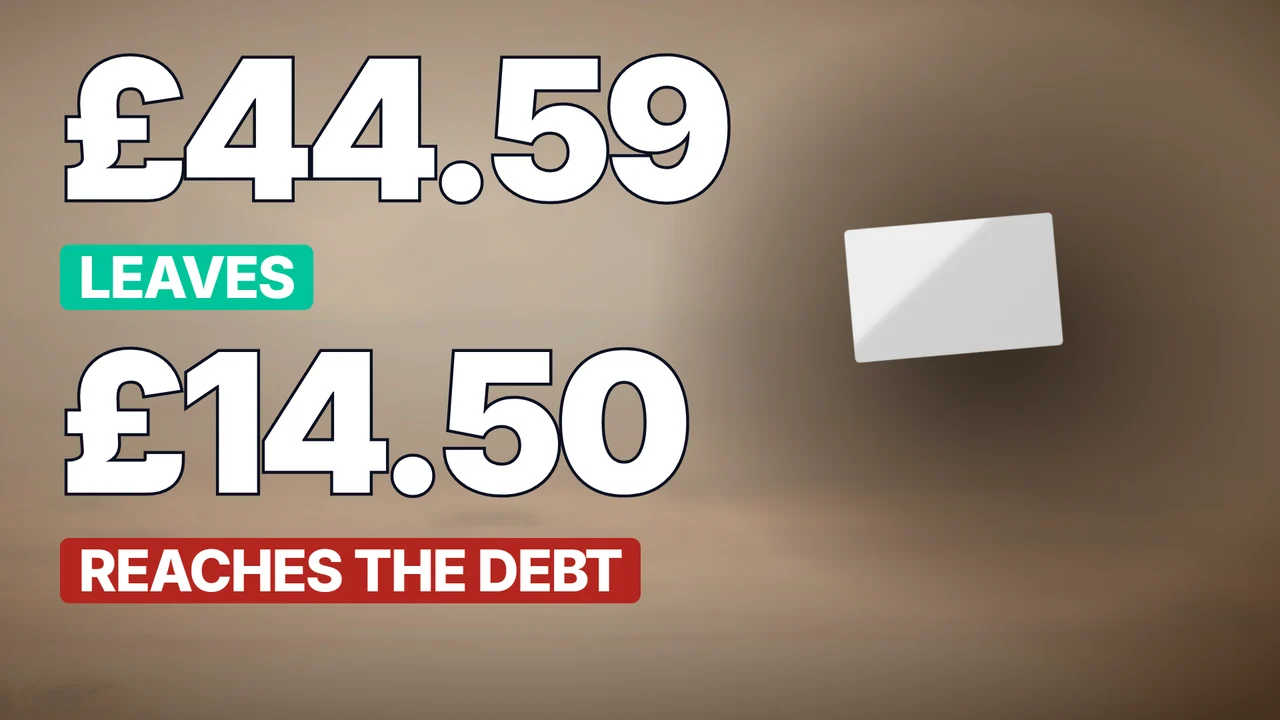
A credit card minimum payment is not a small repayment. It is the interest, plus about one per cent of what you owe. On a £1,450 balance at 24.9% APR the minimum comes to £44.59 a month — and of that, £14.50 reaches the balance. The other £30.09 is rent on money you have already spent.
If you are behind on rent or council tax, deal with that first. Free, independent help: StepChange, Citizens Advice, National Debtline. Nothing on this page is financial advice, and nothing here routes you to a debt product.
The minimum payment, opened up
| Amount | |
|---|---|
| Balance | £1,450.00 |
| APR | 24.9% |
| Interest this month | £30.09 |
| About 1% of the balance | £14.50 |
| Minimum payment | £44.59 |
| Reaches the balance | £14.50 |
That is the whole mechanism. A UK card minimum is built to cover the interest and hand back roughly one per cent of the principal, with a £5 floor. It is designed to be affordable. It is not designed to finish.
What a year of minimums actually does
The minimum falls as the balance falls, so each month you pay slightly less and slightly less comes off. Run it for twelve months:
| After 12 months | Amount |
|---|---|
| Total paid | £506.58 |
| Balance at the start | £1,450.00 |
| Balance at the end | £1,285.26 |
| Taken off the balance | £164.74 |
Five hundred pounds gone, a hundred and sixty-five off the debt. Carry that on and the card takes 273 months — over 22 years — and costs about £4,232 in total.
The part nobody says out loud
Here is where a low income changes the arithmetic rather than just making it harder.
This is a real monthly plan on £1,280 take-home:
| Category | Amount |
|---|---|
| Rent | £620.00 |
| Council tax | £105.00 |
| Energy | £95.00 |
| Water | £32.00 |
| Phone | £38.00 |
| School lunches | £30.00 |
| Car insurance | £35.00 |
| Birthday | £35.00 |
| Groceries | £240.00 |
| Transport | £85.00 |
| Plan, total | £1,315.00 |
The plan costs £1,315 against a wage of £1,280, so the month is £35 short before anything is bought. And look at the list again: there is no card line in it. The £44.59 is an eleventh outflow that the plan never counted.
So the true shortfall is £35.00 + £44.59 = £79.59, and that shortfall goes back on the card. Meanwhile £14.50 comes off it.
£79.59 on, £14.50 off. The balance climbs £65.09 every month — while it is being paid.
That is not a discipline problem. It is arithmetic, and a bank balance will never show it to you, because the money is in the account right up until the moment it is not.
Step one is a month that adds up, not a bigger payment
The instinct is to pay more. Do that on an unbalanced month and the extra payment quietly funds the same hole it came from.
Step one is to get the month to zero with the minimum counted inside it. On this household that is £79.59 a month out of the everyday money. It buys nothing exciting: it just stops the balance rising, which turns £65.09 backwards into £14.50 forwards without paying a penny more than the minimum.
Then price the second step honestly
Everyone says spend less. Almost nobody says what it buys. So:
| Amount | |
|---|---|
| Closes the shortfall (minimum inside the plan) | £79.59 |
| Doubles the card payment | £45.41 |
| Out of the everyday money | £125.00 |
| Everyday money before | £325.00 |
| Everyday money after | £200.00 |
£125 a month is £31.25 a week off a grocery shop and a bus fare, and it leaves £200 a month for both. That is hard, and it would be dishonest to pretend otherwise. Here is what it buys:
| Route | Monthly payment | Time to clear | Total paid |
|---|---|---|---|
| Minimum payments only | £44.59, falling | 273 months (22+ years) | £4,232 |
| Doubled and held | £90.00 | 20 months | £1,783 |
Same card, same wage. The difference is which number leaves the account on payday, and whether you chose it.
How to do this on your own numbers
- Write down the card balance and this month’s minimum payment.
- Split the minimum: the interest first, then what actually reaches the balance. About 1% of what you owe comes off.
- Name every category you spend in this month, and what it costs — bills, dated one-offs, and the everyday ones.
- Add them up against your take-home. If the plan costs more than the wage, that shortfall is going on the card, and the balance is rising while you pay it.
- Get the month to zero first, with the card minimum counted inside the plan.
- Then double the card payment and hold it there — funded on payday like a bill, not paid out of whatever is left at the end.
The method works on paper, in a spreadsheet, or in any envelope app. The arithmetic is what matters, not where you keep it. The debt payoff calculator runs the minimum-only and the doubled route on your own balance and APR, free, in the browser.
The one rule
The card payment is an envelope you fund on payday, not whatever is left at the end of the month.
Frequently asked
How is a credit card minimum payment calculated in the UK? Typically the month’s interest plus about 1% of the balance, with a £5 floor. On £1,450 at 24.9% APR that is £30.09 of interest plus £14.50 of balance: £44.59.
Is the minimum payment just interest? Almost. Of the £44.59 above, £30.09 is interest and £14.50 reaches the balance. A year of minimums pays £506.58 and takes £164.74 off the debt.
What happens if I only ever pay the minimum? The payment shrinks as the balance shrinks, so it never finishes quickly: 273 months (over 22 years) and about £4,232 in total on this £1,450 balance.
Should I pay more than the minimum before my budget balances? Get the month to zero with the minimum counted inside it first. An extra payment on an unbalanced month is funded by the same shortfall it is meant to fix. Then double the payment and fund it on payday like a bill: 20 months and £1,783 here.
This is education about a budgeting method, not financial advice. If the rent or the council tax are already behind, ring StepChange or Citizens Advice before any of this.