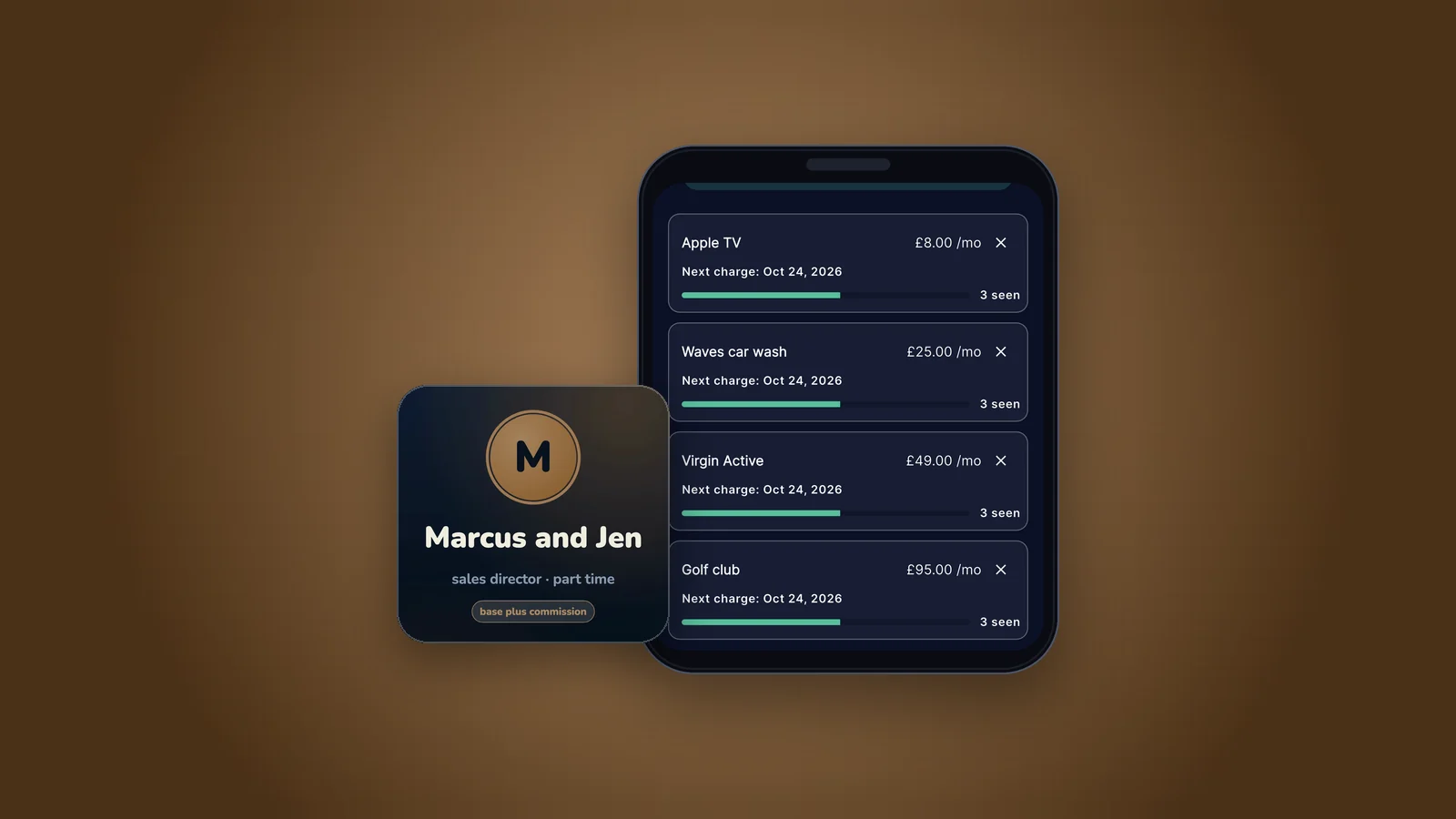
The gym, signed the week the £6,500 quarter landed. Golf, signed the month the £8,000 one came in. A car-wash plan, a streaming upgrade. £177 a month, £2,124 a year, and every one of them is paid in the bad quarters too.
Marcus and Jen. He is a sales director on a base plus commission; she works part time.. The households in these Shorts are illustrations built from typical UK figures, not real people, and every number below is worked on the household’s sheet.
What happened
Marcus is a sales director on a base salary plus commission, and Jen works part time. Their income arrives in two shapes: a dependable monthly base and a quarterly commission that can be generous or thin depending on how the quarter went. Over time Marcus had signed up for four monthly things, each one in a good quarter, and each one now billed every month regardless of what kind of quarter it was. Finding them took nothing more than the bank statement and about four minutes.
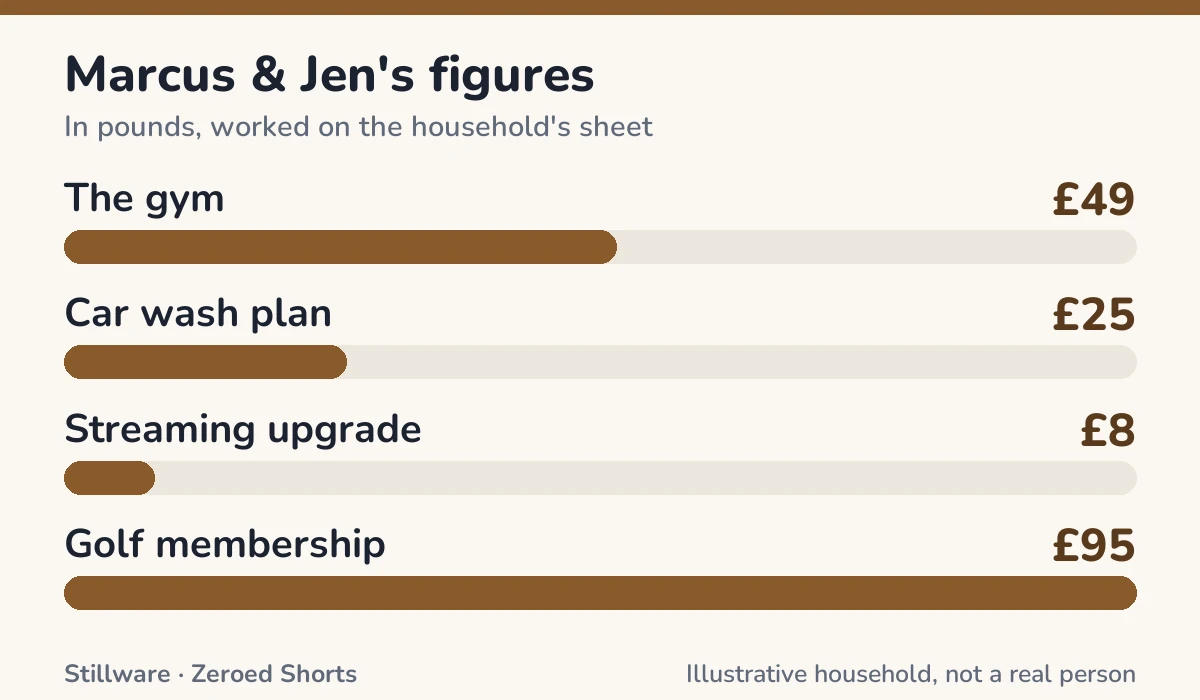
The first was the gym at £49 a month, signed the week a £6,500 commission payment landed. Then a car-wash plan at £25 and a streaming upgrade at £8. The largest was golf, at £95 a month, signed in the month an £8,000 quarter came in. Added together the four came to £177 a month, or £2,124 a year, a sum that had built up one reasonable decision at a time.
The turn was seeing that none of them had been a mistake on the day. With £8,000 sitting in the account, a gym membership or a round of golf looks entirely affordable, and at that moment it was. The problem is who makes the decision. The good month decided, but the bad month pays, and a bad month on commission is not one month long. It is three months long, a whole quarter of the same bills arriving with far less behind them.
That changed the question asked of every line on the statement. It was no longer whether the thing was worth having, but which month had signed it. Where the answer was a good month, the lean months deserved a say before it carried on. The exercise is simple: list every monthly payment and, next to each one, the month it was signed. Where it was a good one, ask whether the bad one agrees.
Marcus did exactly that. He kept the gym and the golf, because both still earned their place, but he stopped treating them as ordinary monthly costs. Both moved into a dedicated Quarter envelope, so a good commission quarter now pays for them in advance and the lean quarters no longer have to carry them. The car-wash plan did not pass the test and was cancelled. The household still has the things it values most, but the bill for them is now settled when the money is there, not when it is not.
The working
Every figure the Short says, and where it comes from on the household’s sheet.
| The Short says | Figures | Derivation |
|---|---|---|
| four things | count of gq_* | on the sheet |
| forty-nine / the six-and-a-half-thousand quarter | gq_gym = 49; commission_q2 = 6,500 | on the sheet |
| twenty-five / eight | gq_carwash = 25; gq_streaming = 8 | on the sheet |
| ninety-five / the eight-thousand quarter | gq_golf = 95; commission_q4 = 8,000 | on the sheet |
| one hundred and seventy-seven / two thousand one hundred and twenty-four | sum of gq_*; gq_subs_month * 12 | on the sheet |
| eight thousand in the account | commission_q4 = 8,000 | on the sheet |
The turn
None of them was a mistake on the day; the good month decided and the bad month pays, and the bad month is three months long.
The Short
Monday
- Every monthly line, and next to it the month you signed.
- If it was a good one, ask the bad one whether it agrees.
In Zeroed
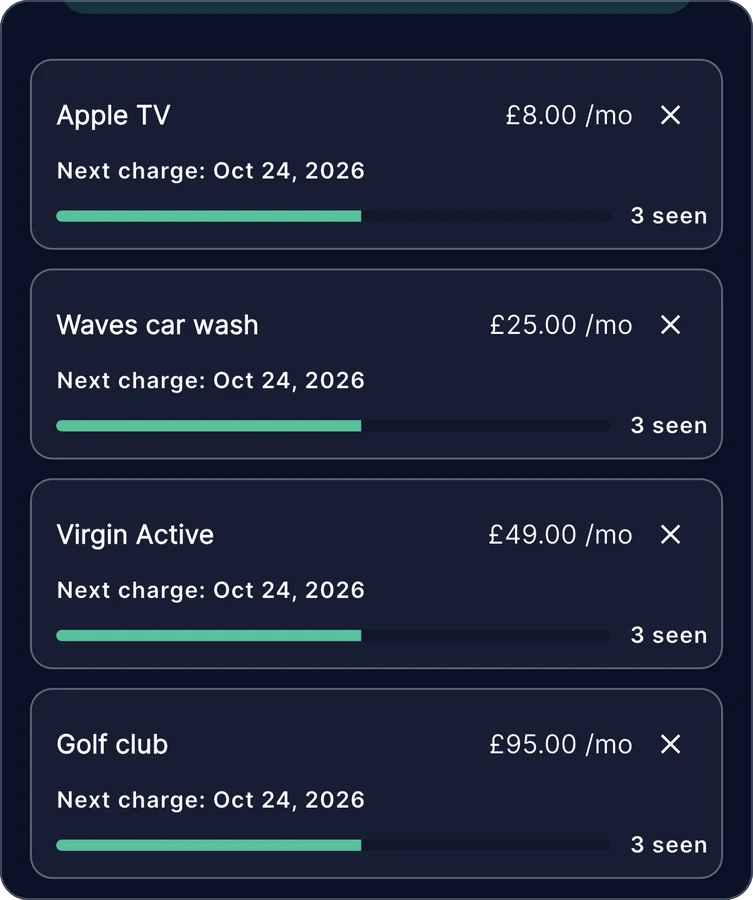
Marcus’s subscriptions screen shows the four lines, one hundred and seventy-seven a month. So the car wash went, and the gym and golf are paid from Quarter.
Zeroed: Offline Budget Planner is the app in the Short — envelope budgeting you buy once. It works offline, with no bank login, no subscription and no data harvesting; the first thirty-four days are free, no card needed. Try Zeroed.