How many bank accounts do you need to budget? Fewer than the internet says — and the number that matters is not how many accounts you open but how many transfers you then make. The popular six-account method costs 260 transfers a year on a weekly payday, because your pay lands in one of the six and you feed the other five every time. And six accounts still cannot keep this household’s ten committed bills apart, so four of them end up sharing a balance anyway — which is the one thing separate accounts were supposed to prevent.
One thing worth saying before the arithmetic: almost everything ranking above this page on that question is published by a company that would open the account for you — a lender, a fintech, a savings platform. That does not make their advice wrong. It does mean nobody in that list has a reason to tell you what running six accounts costs.
The method is right about one thing, and it is the important thing
The usual advice is an account for each job: bills here, spending there, savings somewhere you do not look. That is right, and the reason it works is friction. Money in another account is money you have to decide to go and get, and deciding twice is the whole point. A number on a screen does not stop anybody; a locked account sometimes does.
Keep that. The rest of this page is about what the other five accounts cost you and whether they buy anything.
What six accounts actually cost: 260 transfers a year
Nothing arrives in the right account. Your pay lands in one of them, and then you move it.
| accounts you keep | moves every payday | paydays a year | transfers a year |
|---|---|---|---|
| 6 (the usual advice) | 5 | 52 | 260 |
| 10 (one per envelope) | 9 | 52 | 468 |
| 1 (with named envelopes) | 0 | 52 | 0 |
Two hundred and sixty decisions a year, every one of them a decision you already made when you set the system up. Put them on standing orders and you have saved yourself the Friday — you have not saved yourself the second column. The money still moves, the balances still have to be reconciled, and each account is still a set of terms, a card and a login.
Nobody opens ten. That is why the advice stops at six: not because six is a principle, but because six is what a person can stand.
The household this page uses
Every figure here belongs to one real budget, the same one the video walks through — take-home £1,280 a month, paid weekly at £295.38.
| what it owes | amount | when |
|---|---|---|
| Rent | £620.00 | monthly |
| Council Tax | £105.00 | monthly |
| Energy | £95.00 | monthly |
| Water | £32.00 | monthly |
| Phone | £38.00 | monthly |
| School lunches | £30.00 | this month |
| Car insurance | £35.00 | this month |
| Birthday | £35.00 | this month |
| Groceries | £240.00 | everyday |
| Transport | £85.00 | everyday |
That is ten things with a price on them. Six accounts cannot hold ten numbers, so four of them go in with somebody else — and those four are the ones you will guess about.
Why a shared balance answers the wrong question
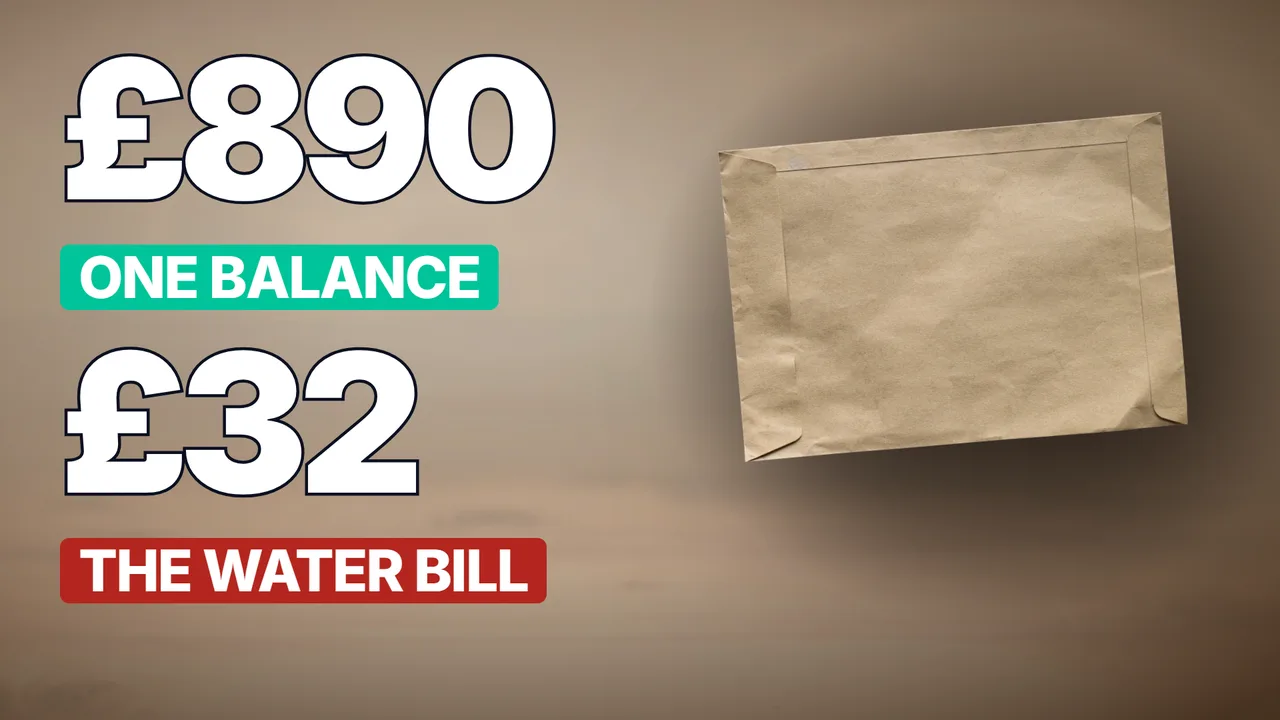
Put the five monthly bills in one “bills account” and it holds £890. On the day the water bill leaves, the account still reads £890, and it cannot tell you whether the rent is safe. The balance answers how much is in here. The question you actually have is which of these is covered.
That is not a failure of discipline. It is what happens when five claims share one number.
A pot is a place; an envelope is a claim
UK banking has made this confusing, because Monzo pots and Starling spaces feel like the answer. A pot is a place: the money moves into it and your main balance drops. An envelope is not a place — it is a claim on the one balance you already have. Ten names point at parts of it and nothing leaves the bank.
That distinction is the whole argument. If the money moves, you are still running transfers; you have just moved them inside one app.
The method, on paper, in four steps
You do not need software for this. You need somewhere to write ten numbers where you can see them together.
- List everything with a price on it — dated bills, this month’s one-offs, and the everyday categories. For this household that is ten lines.
- Count your accounts. If the first number is bigger than the second, some of them share, and you already know you are not going to open one each.
- Fund the list on payday, once, on paper or on a screen. Nothing moves between accounts.
- Keep one locked account if friction is what stops you spending. One is the useful number; the other five only organise what you can already see.
If any of those bills is already behind, that is a different problem and a better first call: StepChange or Citizens Advice, free, before any budgeting method.
Where the ten numbers live
I built Zeroed for exactly this: one current account, ten envelopes, and nothing to move on a Friday. It works offline, there is no bank login, and it is one payment rather than a subscription. Its budget screen is the ten lines above with their own figures beside them, and the only number your bank ever sees is the one balance, because there is one balance.
The method works on paper first, and it should — if a notebook holds your ten numbers where you can read them together, you have the whole benefit and none of the transfers. Related reading: envelope budgeting without bank sync and zero-based budgeting explained simply. If you want to see what your own committed total looks like first, the 50/30/20 budget calculator is a reasonable place to start.
Frequently asked
How many bank accounts should I have in the UK? There is no legal limit — you can hold as many as banks will approve. Practically: one current account for the money to land in, plus one you find hard to reach if friction is what stops you spending. Adding accounts beyond that adds transfers, not clarity.
Does the six-account method work? It works in the sense that it stops you spending committed money, and that is real. It costs 260 transfers a year on a weekly payday, and it cannot separate more claims than you have accounts.
Are Monzo pots or Starling spaces the same as envelopes? No. A pot moves money out of your main balance; an envelope is a claim on a balance that stays put. Pots are a real improvement on six separate banks, but you are still moving money.
What if my bills are already behind? Ring StepChange or Citizens Advice first. Both are free, and neither budgeting method fixes arrears.
This is education about a budgeting method, not financial advice. Zeroed is my own product, which is why the method above is written to work on paper first.