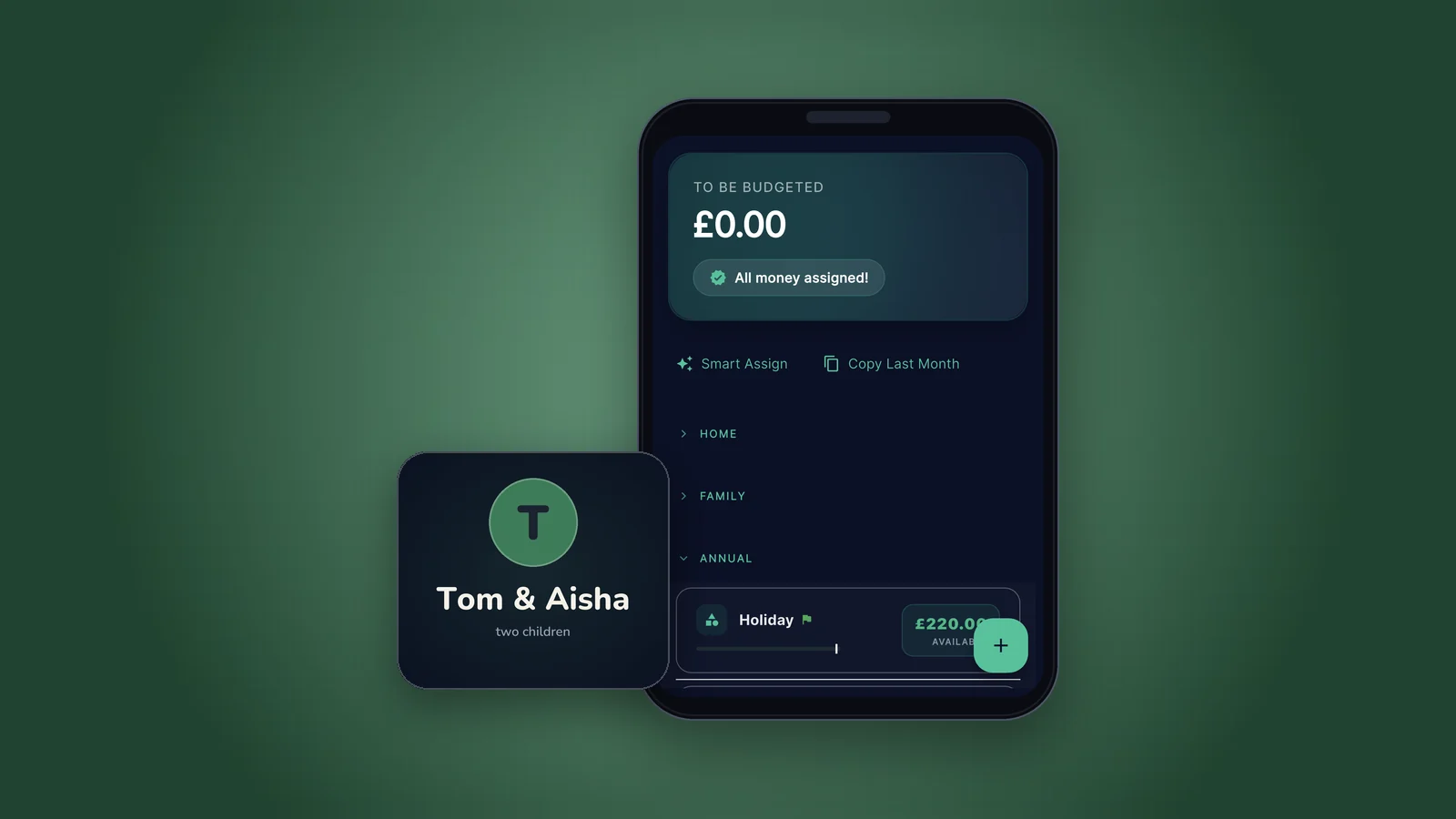
Tom and Aisha each put £2,200 into the joint account three years ago, when it was fair. Then the second child started nursery and nobody changed the number. They are not short of money. They are short of a total.
Tom and Aisha, two children. The households in these Shorts are illustrations built from typical UK figures, not real people, and every number below is worked on the household’s sheet.
What happened
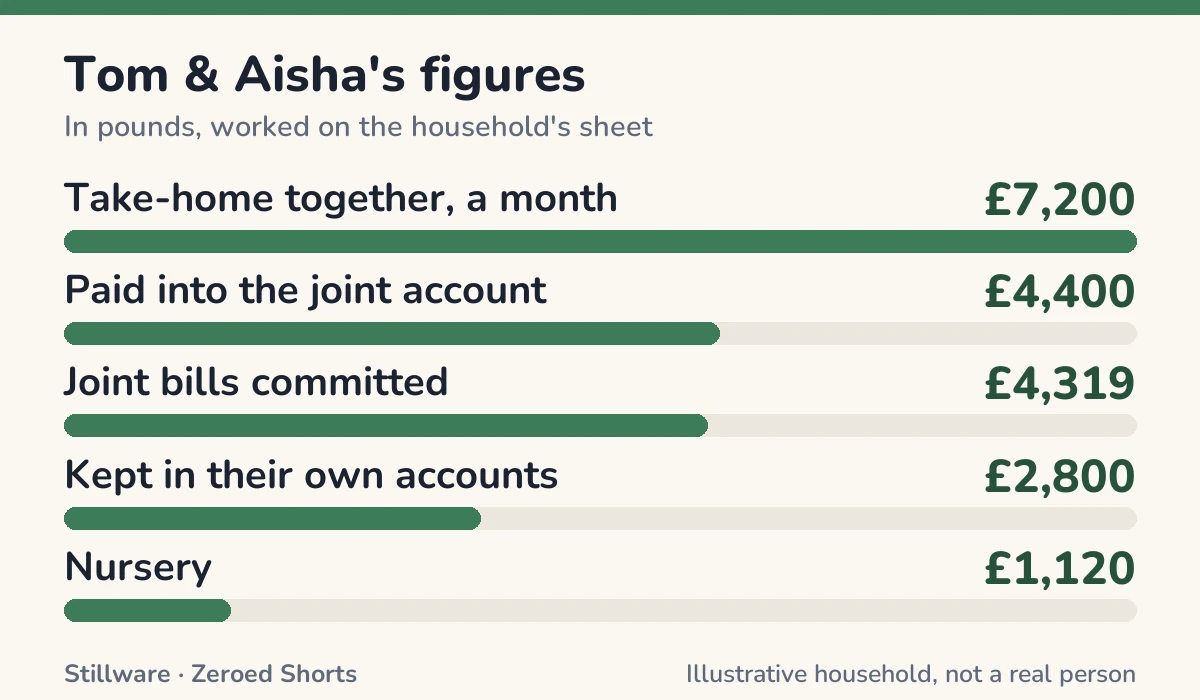
The argument in Tom and Aisha’s house never changes. He says the nursery is too expensive; she says the car costs too much. They have two children and take home £7,200 a month between them, £3,800 from Tom and £3,400 from Aisha, and yet every single month the joint account runs down to £81. Each of them has a culprit in mind, and each of them is wrong. The real reason is a number nobody in the house had ever said out loud.
The setup dates back three years. At that point they agreed to pay £2,200 each into the joint account, and for the bills they had then, it was a fair arrangement. Then their second child started nursery, at £1,120 a month, and that cost went straight onto the joint account. Nobody went back and changed the £2,200. So the joint account now has to carry the mortgage, the nursery, the car, the food shopping and the bills, which together come to £4,319, and it receives £4,400 to do it. The gap between those two figures is the £81. Meanwhile, £2,800 a month lands in their two personal accounts, and every July the family holiday goes on a credit card.
The couple were not short of money at all. What they were short of was a total. So they sat down together with a single sheet of paper and three numbers. The first was everything that comes in: £7,200. The second was everything already spoken for before the month even starts: £4,319. The third was what was left over, and whose it was: £2,881. When they looked at that last figure honestly, the answer to whose it was turned out to be nobody’s. It had no owner and no job, which is why it kept disappearing and why the arguments kept coming back.
The fix was not simply to raise the transfer into the joint account. Instead they made one plan covering the whole £7,200. Within it, each of them now has a no-questions envelope of £400 a month to spend without having to explain it to the other. And the holiday that always used to land on the card got an envelope of its own, taking £220 a month from August onwards, so that by the following July it would already be paid for rather than borrowed.
The three numbers they wrote down work for any couple having the same row: what comes in, what is spoken for, and what is left and whose it is. If the answer to the third question is nobody, that is where the argument lives. For Tom and Aisha, every pound now has an owner, and the holiday envelope grows by £220 each month.
The working
Every figure the Short says, and where it comes from on the household’s sheet.
| The Short says | Figures | Derivation |
|---|---|---|
| seven thousand two hundred / eighty-one pounds | tom + aisha; joint_in - joint_committed | on the sheet |
| two thousand two hundred | joint_each = 2,200 | on the sheet |
| eleven hundred and twenty | nursery = 1,120 | on the sheet |
| four thousand three hundred and nineteen / four thousand four hundred | mortgage + nursery + car_finance + groceries + bills; joint_each * 2 | on the sheet |
| two thousand eight hundred | (tom - joint_each) + (aisha - joint_each) | on the sheet |
| seven thousand two hundred / four thousand three hundred and nineteen | takehome = 7,200; joint_committed = 4,319 | takehome = tom + aisha; joint_committed = mortgage + nursery + car_finance + groceries + bills |
| two thousand eight hundred and eighty-one | takehome - joint_committed | on the sheet |
The turn
Both are wrong; the joint transfer was fair for the bills they had three years ago, and the real number has never been said.
The Short
Monday
- Your three numbers — what comes in, what is spoken for, what is left and whose it is.
- If the third is nobody’s, that is the argument.
In Zeroed
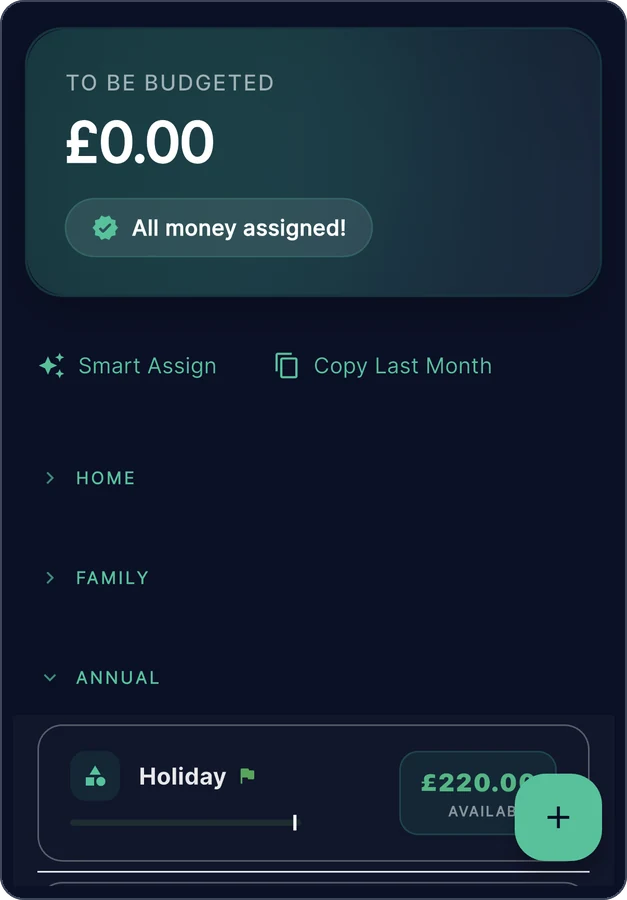
Tom and Aisha’s three accounts sit in one budget. To Be Budgeted reads zero, and the holiday envelope is two hundred and twenty further on each month.
Zeroed: Offline Budget Planner is the app in the Short — envelope budgeting you buy once. It works offline, with no bank login, no subscription and no data harvesting; the first thirty-four days are free, no card needed. Try Zeroed.