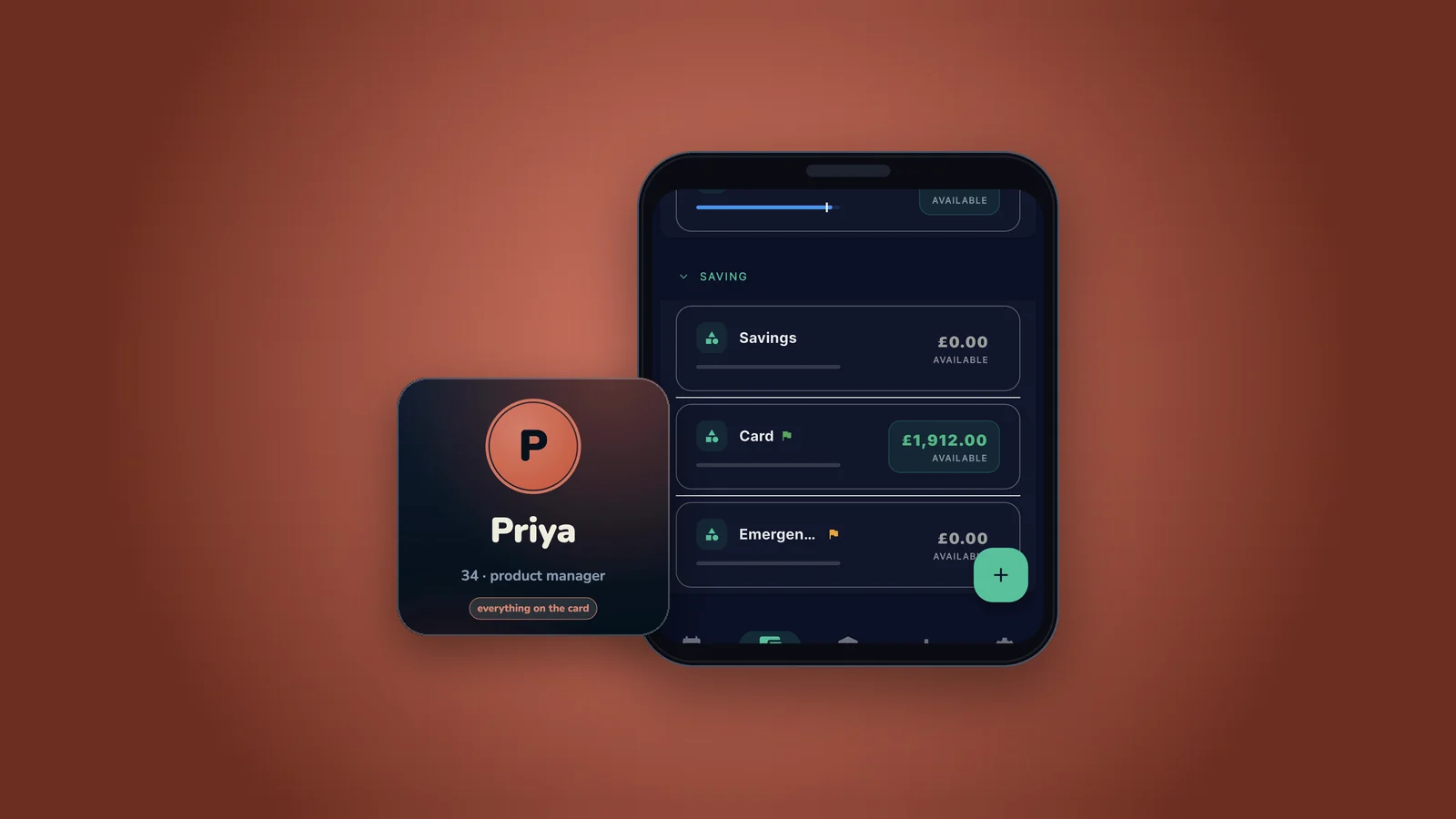
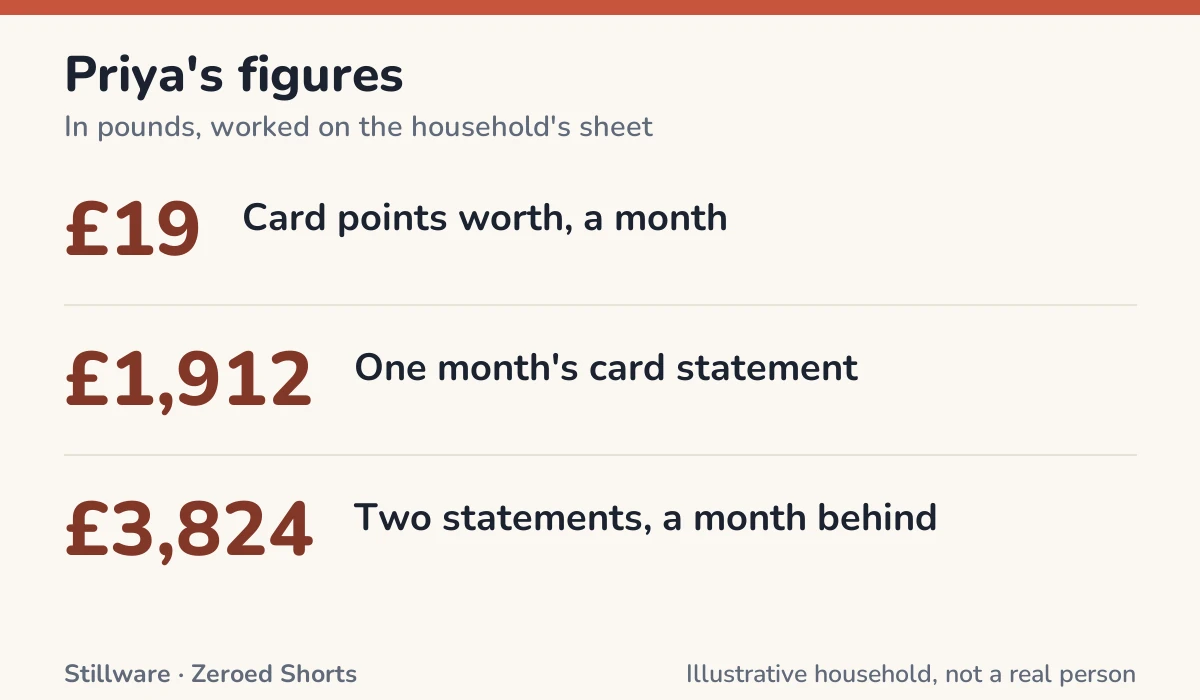
Priya pays her credit card in full every month and is a month behind. Both are true: everything goes on the card for £19 of points, so every purchase is paid by next month’s salary, and if one payday is late two statements, £3,824, fall due at once. The fix is one envelope, and one hard month.
Priya, thirty-four, product manager. The households in these Shorts are illustrations built from typical UK figures, not real people, and every number below is worked on the household’s sheet.
What happened
Everything Priya can put on her credit card goes on it, for the points. They are worth about £19 a month, and she clears the balance in full every single month. By any ordinary measure she is doing it properly. She is thirty-four, a product manager, and she is also, as it turned out, permanently a month behind. Both things were true at once, and the question worth asking was what those points were really costing.
The statement comes to £1,912. On payday it is the first thing to leave her account, ahead of rent and everything else. What remains after that is this month’s pay with last month’s spending already taken out of it. Nothing is ever overdue and nothing ever charges interest, so nothing feels wrong, and for as long as she has had the card, nothing has gone wrong. The weakness only shows when the rhythm breaks. If one payday arrives late, or one month runs short, two statements fall due together: £3,824, with nothing set aside for either of them.
Paying in full feels like the very opposite of being in debt. It is actually a loan, only a short one. It lasts a month, it is renewed with every statement, and it stays invisible precisely because it always gets paid. To see it, Priya wrote down two numbers on payday: the card balance, and what was left in her account once the bills had gone. The card balance was the bigger of the two, and the difference was roughly a month’s worth of spending. That was the float she had been living on without noticing.
The answer was not to cut the card up or give up the points. It was to give each statement its own envelope. Through the month, money goes into that envelope as she spends on the card, so when the statement arrives it is paid from money already set aside, not from the next salary. There is a cost to the switch, and it lands once. For a single month she has to cover both this month’s envelope and last month’s card. After that, the float is gone for good, and the points really are free.
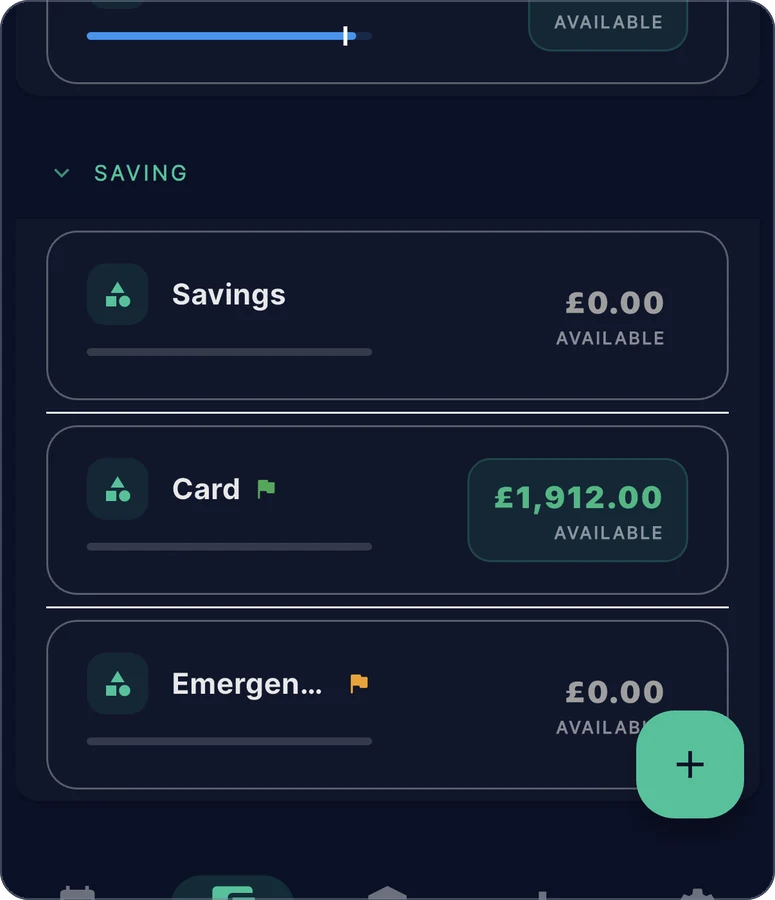
The test she used works for anyone who pays a card in full: on payday, write down the card balance and the account balance after bills. If the card is the bigger number, the household is on the float. For Priya, the card envelope now holds £1,912 by statement day, and nothing is left waiting for payday.
The working
Every figure the Short says, and where it comes from on the household’s sheet.
| The Short says | Figures | Derivation |
|---|---|---|
| about nineteen pounds a month | points_value = 19 | on the sheet |
| one thousand nine hundred and twelve | card_statement = 1,912 | on the sheet |
| three thousand eight hundred and twenty-four | card_statement * 2 | on the sheet |
| by about a month | months_behind = 1 | on the sheet |
The turn
Paying in full feels like the opposite of debt; it is a one-month loan renewed every statement, invisible because it is always paid.
The Short
Monday
- On payday write two numbers, the card balance and the account after bills.
- If the card is bigger, you are on the float, and the fix is one envelope per statement.
In Zeroed
Priya’s card is an account beside her envelopes. The Card envelope holds one thousand nine hundred and twelve on statement day, and nothing waits for payday.
Zeroed: Offline Budget Planner is the app in the Short — envelope budgeting you buy once. It works offline, with no bank login, no subscription and no data harvesting; the first thirty-four days are free, no card needed. Try Zeroed.