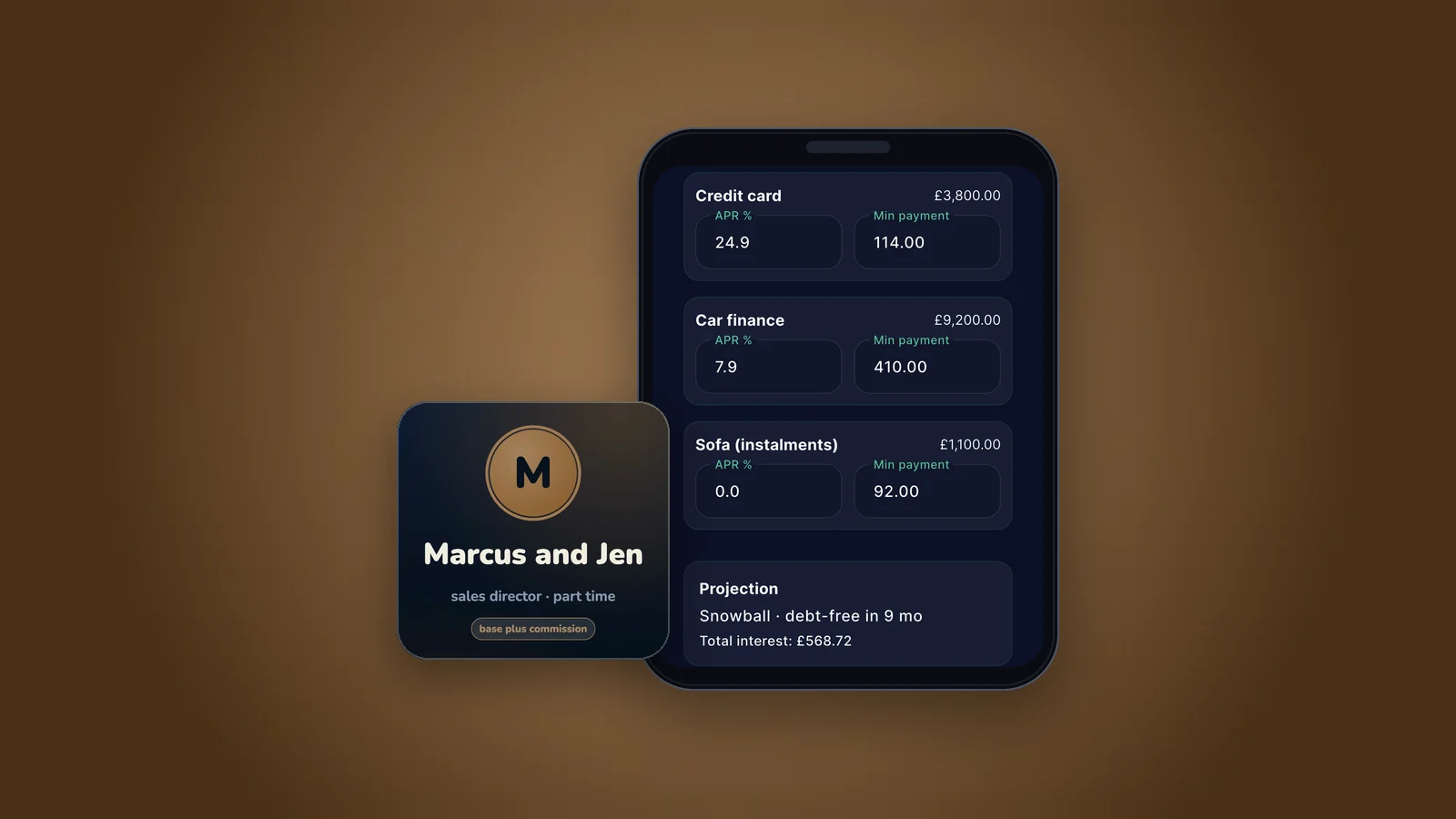
Ask Marcus and Jen if they have any debt and they will say no. £616 a month in minimum payments says otherwise: a sofa, a card and a car that add up to £14,100, a number nobody in the house had ever said out loud. At their spare, it ends in eight months, once it has a total.
Marcus and Jen. He is a sales director on a base plus commission; she works part time.. The households in these Shorts are illustrations built from typical UK figures, not real people, and every number below is worked on the household’s sheet.
What happened
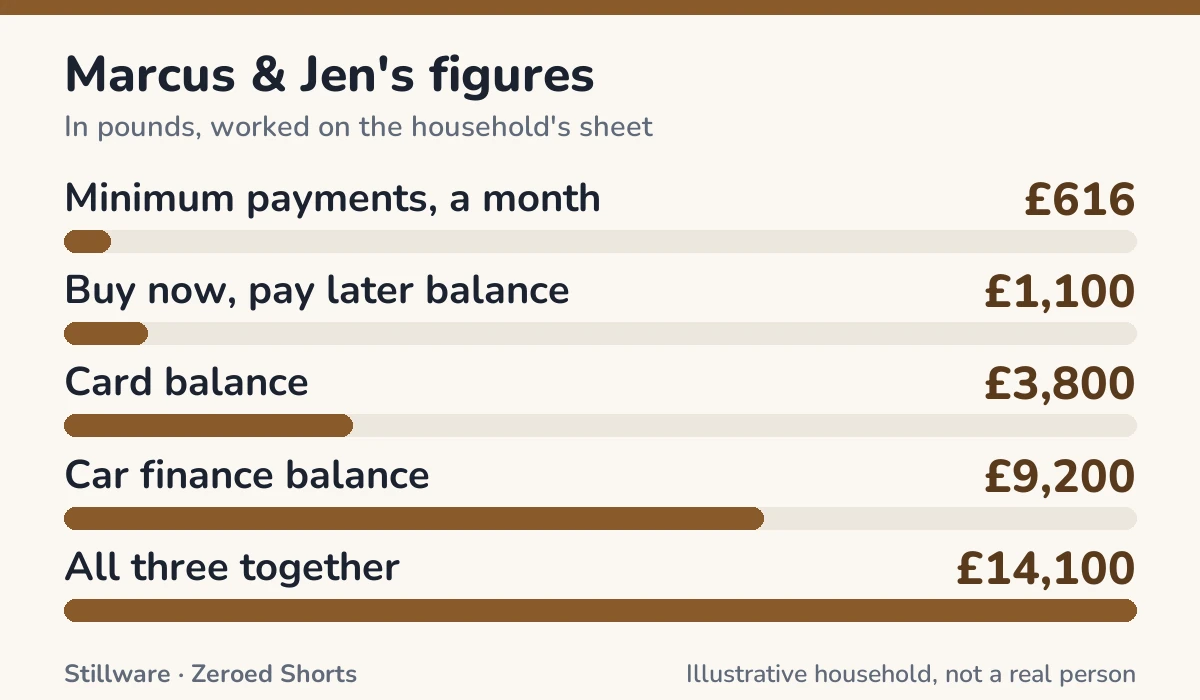
It started with a sofa. Marcus and Jen bought one on instalments, and it costs them £92 a month, with £1,100 still to pay. Nobody thinks of a sofa as debt. Ask the couple whether they owe anything and they will tell you they do not. He is a sales director on a base salary plus commission, and she works part time. Between them, though, they pay £616 a month in minimum payments, which tells a different story.
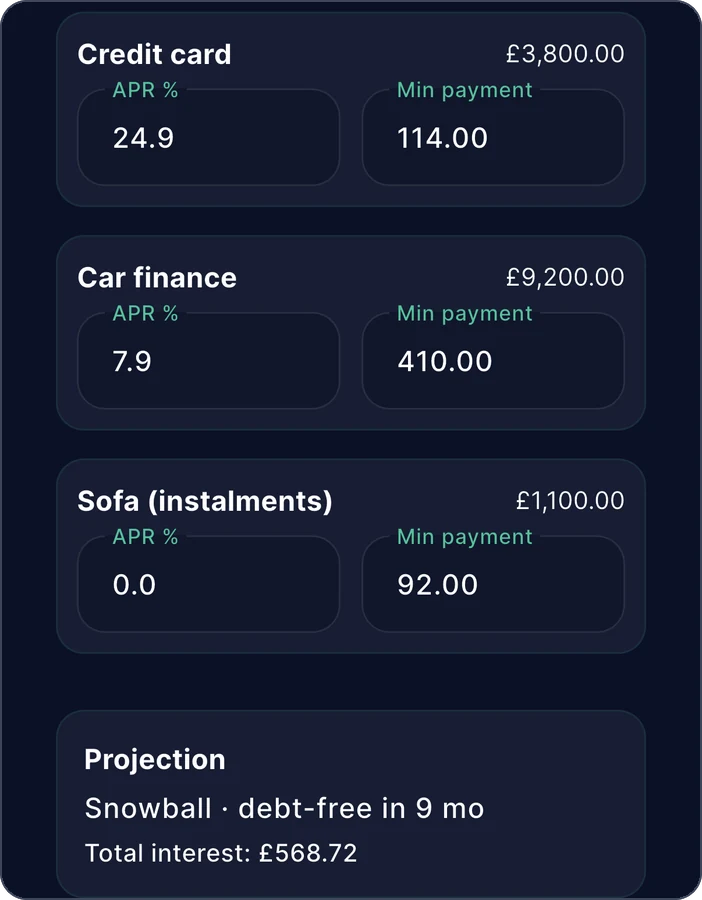
The sofa was only the first of three. Next came the credit card, carrying £3,800, which they always meant to clear once the commission landed. Until then, the minimum of £114 went out each month. Then there was the car, at £410 a month, with £9,200 still owed on it. Nobody in that house would have called the car borrowing either. Each of the three had its own name and its own payment, and each one felt manageable. What they came to together was a question no one had ever asked.
When they finally added them up, once, on the back of an envelope, the total was £14,100. Marcus read it twice. Nobody had said that number aloud before, because nothing they owned was called debt. It was called the sofa, the card, the car. They had not borrowed £14,100 in any sense they recognised; they had borrowed three small things with three separate names. And a name, it turned out, is exactly what stops a number from ever being added up.
Once there was a total, a better question followed: when does it end? In a month when only the base salary comes in, they have £1,200 spare. Put that together with the minimums they are already paying and the household can put £1,816 a month towards what it owes. At that pace, £14,100 is cleared in eight months, before interest is taken into account. With interest included, it stretches to nine. Either way, it is a number of months they can name, and no longer an open-ended someday.
The whole exercise came down to a single line: every balance that has a payment attached to it, added together and said out loud. For Marcus and Jen, that line turned three comfortable-sounding payments into one figure, and the figure turned into a date. Once the debt had a total, it also had an end.
The working
Every figure the Short says, and where it comes from on the household’s sheet.
| The Short says | Figures | Derivation |
|---|---|---|
| six hundred and sixteen pounds a month | minimums = 616 | minimums = card_min + car1_finance + bnpl_payment |
| ninety-two a month / eleven hundred | bnpl_payment = 92; bnpl = 1,100 | on the sheet |
| three thousand eight hundred / one hundred and fourteen | card = 3,800; card_min = 114 | card_min = round(card * 0.03) |
| four hundred and ten / nine thousand two hundred | car1_finance = 410; car1_balance = 9,200 | on the sheet |
| fourteen thousand one hundred | car1_balance + bnpl + card | on the sheet |
| twelve hundred pounds spare | base_spare = 1,200 | base_spare = base_total - fixed |
| eighteen hundred and sixteen / eight months, before interest | minimums + base_spare; ceil(debt_total / payoff_monthly) | on the sheet |
The turn
Nobody borrowed fourteen thousand; they borrowed three small things with three names, and a name is what stops a number being added up.
The Short
Monday
- One line, every balance with a payment on it, added up and said out loud.
- Once it has a total it has an end date.
In Zeroed
the debt planner holds Marcus and Jen’s three balances and their minimums. With interest counted, it says debt-free in nine months.
Zeroed: Offline Budget Planner is the app in the Short — envelope budgeting you buy once. It works offline, with no bank login, no subscription and no data harvesting; the first thirty-four days are free, no card needed. Try Zeroed.