
The Unseen Cost of Constant Connectivity
Modern software has conditioned us to believe that an internet connection is a prerequisite for functionality. We accept the loading spinners, the “cannot connect” errors, and the quiet background data transfers as the price of admission. This is a design choice, not a technical necessity. Offline-first architecture—where the app is fully functional without a network—isn’t a nostalgic throwback; it’s a superior, user-centric model that reclaims control, reliability, and sovereignty. Choosing an offline-first app is a deliberate vote for software that serves you, not a remote server’s business model. This is the core reason why offline apps are better for the modern user.
Benefit #1: Uncompromising Data Ownership
When your data lives primarily on a company’s server, you are not the owner; you are a tenant. You have a license to access your information, contingent on their infrastructure, their policies, and their continued existence. Offline-first apps flip this dynamic. Your data’s canonical home is the device in your hand or on your desk.
- You Hold the Keys: In an offline-first model, encryption keys never leave your device. This means a service provider cannot access, scan, or monetize your data, even if they wanted to. A breach of their servers yields nothing of value.
- No Silent Middlemen: Cloud-dependent apps often use your data for “service improvement,” which is a euphemism for analytics and telemetry. An offline app has no need to phone home with usage statistics; its performance metrics begin and end with your local experience.
- True Portability: Your data isn’t locked into a proprietary web portal. It exists as files you can see, manage, and back up using your own methods. Want to move it? Copy the file. It’s that simple.
This principle is core to how we built Zeroed. Your budget data is encrypted and stored locally. If you choose to sync across devices, you use your Google Drive as a passive storage locker—we provide the encrypted container, but you control the space and the access. As we’ve detailed in our deep dive on how Zeroed encrypts your data without a server, this architecture means we literally cannot sell or leak your financial information.

Benefit #2: Unmatched Reliability and Performance
An app that requires a server handshake to open a document or save a change introduces multiple points of failure: your Wi-Fi, your ISP, the app’s servers, and the internet backbone between them. Offline-first software eliminates every single one.
- Works Anywhere, Anytime: On a plane, in a basement, during an internet outage, or in a rural area with spotty service—the app works identically. Your productivity is no longer geographically constrained.
- Native Speed: Operations happen at the speed of your device’s processor, not the speed of a network round-trip. Opening, searching, and saving are instantaneous. This is the difference between a local file and a website; one feels immediate, the other feels mediated.
- Predictable Longevity: The lifespan of the software is tied to your device’s compatibility, not a company’s decision to sunset a server. How many web-based services have you used that simply vanished one day, taking your data and workflow with them? An offline app you’ve purchased remains in your control.
Consider bank imports. Most finance apps rely on fragile third-party API connections that break frequently, leaving you unable to update your budget. Zeroed’s approach uses a universal parser for CSVs and PDFs and a local OCR scanner. It works by processing the document on your device. No broken API, no disconnections—just a fast, reliable import that works because the core logic doesn’t depend on a distant server being in a good mood.
Benefit #3: Transparent, Lifetime Cost Control
The subscription model is the economic engine of cloud-dependent software. You are not just paying for the code; you are renting server time, bandwidth, and database storage. This creates a permanent, recurring financial obligation for you, and a perverse incentive for the company to keep you locked in.
Offline-first architecture naturally aligns with one-time pricing. The cost of development is front-loaded; there is no ongoing server cost per user. This allows for a simple transaction: you pay once, you own the software forever. This is a major reason why offline apps are better for your wallet.
| Cost Factor | Cloud-Dependent App (Subscription) | Offline-First App (One-Time Purchase) |
|---|---|---|
| Primary Cost Model | Recurring fee (monthly/yearly) | Single, upfront payment |
| What You’re Funding | Code + Continuous server/storage costs | Code + Lifetime of updates |
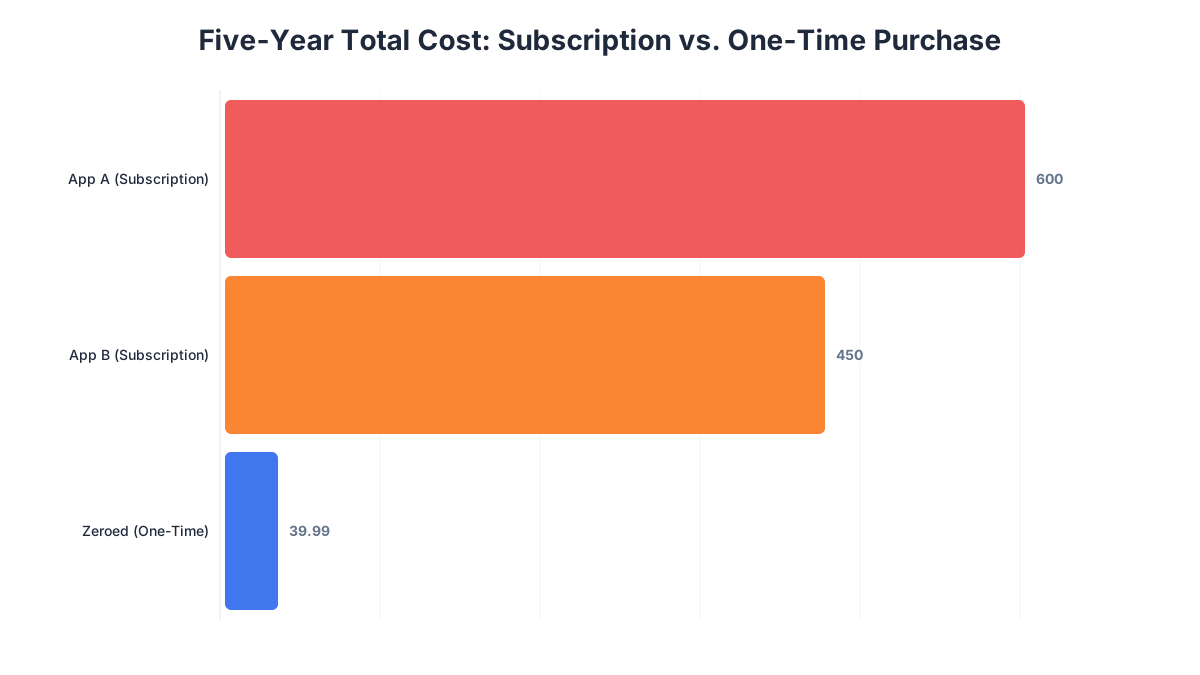
| 5-Year Cost (Example) | $10/month = $600 | One payment of $19.99 (founder price; $39.99 after 14 Feb 2027) |
| Long-Term Value | You stop paying, you lose access. | You own a working tool indefinitely. |
| Vendor Incentive | Retain you at all costs; often via data lock-in. | Deliver a quality product that stands the test of time. |
The financial upside is staggering. As we explored in our analysis of the true cost of YNAB over 5 years, subscription costs compound into a significant sum. A one-time purchase isn’t just cheaper; it’s a capital investment in a tool, not an operational expense for a service. We’ve written more about where we draw this line — why we don’t do subscriptions for software that runs on your device.
The Offline-First Mindset: Beyond the App
Adopting offline-first software is more than a technical preference; it’s a mindset of intentional ownership. It asks a simple question: “Who does this tool ultimately serve?” When the answer is “you,” the design decisions change radically. Features are judged by their local utility, not their data-harvesting potential. Updates are driven by genuine improvement, not by the need to create a new subscription tier.
This mindset extends beyond budgeting. It applies to note-taking, photo editing, project management, and more. In each case, the offline-first alternative prioritizes your autonomy, your privacy, and your long-term independence from the volatility of the web.
The next time you evaluate software, look past the glossy marketing for the “seamless cloud experience.” Ask instead: Does it need the internet to perform its core function? Where does my data live, really? What is the true 5-year cost?
The answers will often lead you to a quieter, more powerful, and more permanent class of software—one that works for you, on your terms. Full disclosure: we built Zeroed to be a definitive example of this principle in action, proving that you can have a premium, private financial tool without renting your data or your budget.
Try Zeroed free for 34 days—offline-first, one-time purchase, and every feature unlocked from day one. See the difference for yourself.
Try Zeroed Free — Offline-First Budgeting You Own
Try Zeroed Free