
Why Is Nobody Prepared for the 2 AM Claim?
You know exactly what’s in your living room right now — the couch you bought last year, the TV, that floor lamp from the flea market. Could you list every item in your apartment from memory? Could you name the model numbers? If you’re like most renters, a home inventory for insurance renters is something you’ve thought about but never actually completed.
Here’s the uncomfortable truth: you’ll never need it until the moment you desperately do. A pipe bursts at 11 PM. Someone kicks in your door while you’re at work. A fire starts in the neighbor’s unit. In that moment, your insurance company asks a simple question that suddenly feels impossible: “What did you own?”
Claims adjusters don’t take your word for it. They don’t accept “I had a TV and some furniture.” They want serial numbers, purchase dates, receipts, and proof. Without documentation, you’re leaving thousands of dollars on the table — money you already paid premiums to protect.
We’ve spent months researching home inventory tools, insurance claim processes, and what actually happens when renters file claims. Most renters have no usable record of their belongings, and the few who try fall into the same traps. This guide walks through why documenting your belongings matters, what to record, and the system that survives a real emergency.
What Insurance Companies Actually Pay Out for Renters Claims
Let’s talk numbers, because the cost of inaction is concrete.
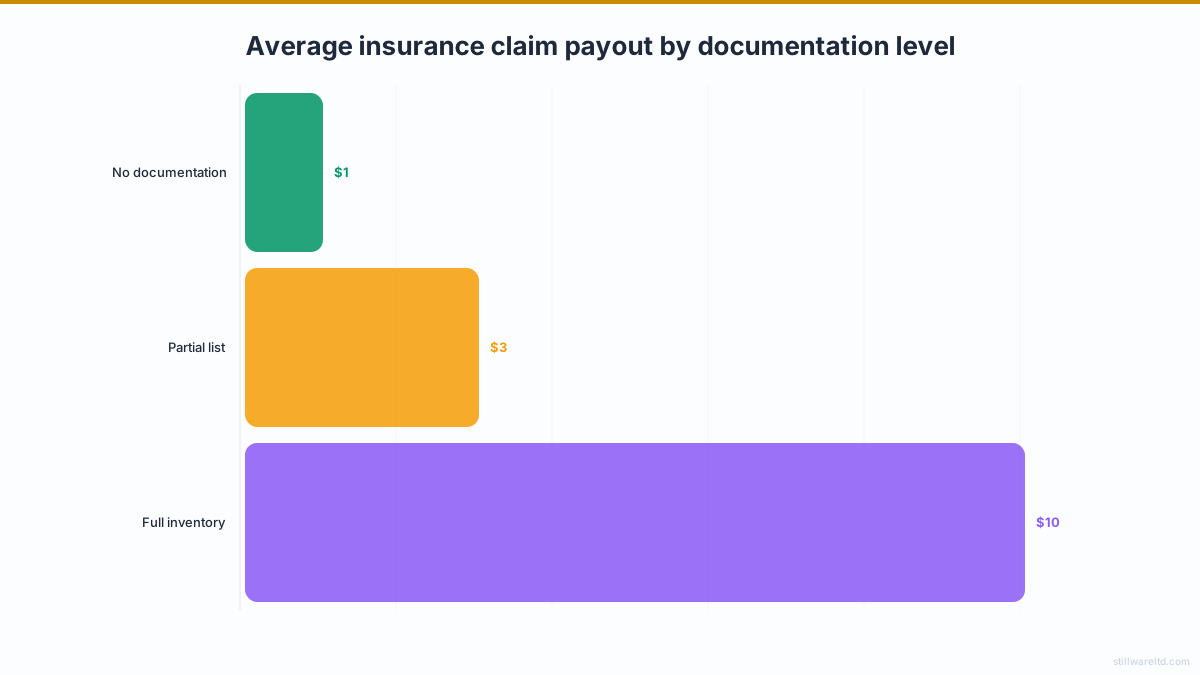
The average renters insurance claim for property damage pays out somewhere between $3,000 and $5,000. That’s the median — half of claimants receive less. But here’s the catch: claims adjusters only pay for items you can prove you owned.
| Scenario | Items Lost | Documentation | Claim Payout |
|---|---|---|---|
| No inventory | ”Some furniture, a TV, clothes” | Verbal description only | $800 – $1,500 |
| Partial list | Clothing, electronics named | Photos, no serials | $2,500 – $4,000 |
| Full documented inventory | Serial numbers, receipts, photos | Complete itemized list with proof | $5,000 – $15,000+ |
Those numbers aren’t hypothetical. Insurance adjusters work from itemized lists. They process claims faster and more generously when policyholders present organized documentation. Vague claims get adjuster estimates — which always land on the conservative side.
The difference between a $1,000 payout and a $10,000 payout isn’t luck. It’s documentation.
That gap represents real money. Your laptop alone costs $1,200 to replace. Your wardrobe? Easily $2,000 if you had to buy everything new at once. Kitchen appliances, bedding, towels, shoes — it adds up faster than anyone expects.
Renters walk through their apartment every day surrounded by $20,000–$40,000 of stuff. Most of them couldn’t document $500 of it under pressure. That’s the gap this guide closes.
Home Inventory for Insurance Renters: What to Document
Before you start photographing everything you own, understand what matters. A home inventory for insurance renters isn’t about cataloging every spoon. It’s about capturing the items that would cost real money to replace.
Electronics. TV, laptop, tablet, phone, gaming console, headphones, camera, speakers. These depreciate but they’re expensive to replace. Serial numbers matter here more than anywhere else — insurance companies recover stolen electronics with serial numbers, and they’ll deny claims for items you can’t uniquely identify.
Furniture. Couch, bed frame, mattress, dressers, dining table, chairs, bookshelves, desks. You don’t need serial numbers for furniture. Photographs showing condition and quality matter more. That mid-century credenza? Document it. A claims adjuster won’t pay “replacement value” for premium furniture without evidence it existed.
Appliances. Microwave, air conditioner, vacuum, washer/dryer if you own them. For kitchen appliances, model numbers help. Most have a sticker on the back or bottom with the model and serial.
Clothing and accessories. Here’s where people fail hardest. A full wardrobe costs $3,000–$5,000 to replace, but most renters document none of it. You don’t need to count every t-shirt. Estimate categories: “15 pairs of shoes, approximately $60 each” with a few photos of your closet to establish volume.
Kitchen items. Small appliances, cookware, knives, dining sets. These items are individually cheap but collectively expensive. A kitchen drawer full of utensils costs $300 to restock. A good set of pots and pans runs $500.
Bedding and linens. Sheets, towels, comforters, pillows. Again, cheap individually, pricey in aggregate. One photo of your linen closet plus a rough count covers this category.
Books, media, and hobby gear. Books, records, games, sports equipment, art supplies, musical instruments. Instruments deserve special attention — if you own a guitar worth more than a few hundred dollars, document it separately with serial numbers.
Important papers and valuables. Passport, birth certificate, lease agreement, jewelry, watches, cash. Jewelry often requires separate riders on renters policies anyway. If you own pieces worth more than $1,000–$2,000 individually, check your policy limits.
The rule of thumb: if replacing it would cost more than $100, it goes on the list. Document what you’d genuinely struggle to replace after a total loss.
Why Most Home Inventory Attempts Fail
Everyone eventually realizes they need some form of home inventory for insurance renters. The attempts follow a predictable pattern.
Attempt one: the spreadsheet. You open Google Sheets with good intentions. You list “couch — $800” and maybe eleven other items before you hit a wall. The problem isn’t laziness — it’s that spreadsheets demand categorization, format decisions, and consistency you don’t have time for. Your list ends up half-finished, stuffed in a notes app somewhere, and never updated.
Attempt two: the photo walkthrough. You take a video of every room with your phone, narrating what you see. This feels productive. It isn’t. A video gives you no itemized breakdown, no searchable format, and no place to attach serial numbers or receipts. When your claim adjuster asks for “an inventory,” a nine-minute walking video doesn’t file well.
Attempt three: the receipt shoebox. You start keeping receipts for major purchases. This fails for two reasons. Most receipts are thermal paper that fades to blank within months. And receipts only cover new purchases — they don’t retroactively document the furniture you bought three years ago.
None of these systems survive the moment they’re needed. When you’re making a claim at 11 PM after a pipe burst, a spreadsheet in your email drafts won’t help. A video on your phone that got wiped when the water damaged it won’t either.
Here’s what actually fails most people: they can’t access their inventory when the disaster happens, and they can’t prove the items existed without serial numbers and dated photos.
After researching dozens of home management tools, one pattern stands out: most home apps assume your data belongs on their servers. That creates a fundamental trust problem. When you upload your full home inventory — including serial numbers, receipts, and purchase values — you’re handing a company a complete map of everything you own. If that company gets breached, criminals now know exactly what’s in your apartment and where to look for it.
We believe home tools should work offline by default. Your inventory of possessions is intensely private. It doesn’t need to live on someone else’s infrastructure to be useful.
The Room-by-Room Home Inventory Checklist That Works
Let’s build your home inventory for insurance renters properly. Print this checklist. Tack it to your closet door. Work through one room per evening — the whole process takes about two hours across a week.
What you’ll need before you start:
- A camera (your phone works)
- Access to model and serial numbers (check stickers on devices)
- Rough purchase dates and prices (credit card statements help; estimates are acceptable)
- A digital home for the final inventory (local storage that survives — more on this below)
The process for each room:
- Video overview. Stand at the door, rotate slowly, capture everything in the room. This establishes the ceiling of what you own.
- Photograph individual items. Focus on anything worth over $100. Include identifying marks — logos, model numbers, distinctive damage or wear.
- Capture serial numbers. For electronics and appliances, photograph each serial number label directly. Your phone camera will get a better read than your eyes.
- Note the details. For each item, write down: estimated purchase year, rough price paid, brand, and model. “Media cabinet, 2019, $300, IKEA” takes ten seconds and covers you.
- Store receipts digitally. Photograph paper receipts immediately. Most fade within months; the photo won’t.
The room order that minimizes effort:
| Room | Time Needed | Priority Items |
|---|---|---|
| Electronics & home office | 25 min | Laptops, TV, console, camera, headphones |
| Bedrooms | 20 min per room | Clothing totals, bed frame, dresser, jewelry |
| Kitchen | 20 min | Appliances, cookware, dining sets |
| Living room | 15 min | Couch, media console, lamps, artwork |
| Bathrooms & closets | 10 min per space | Linens, toiletries stockpile, meds |
| Storage | 15 min | Seasonal gear, tools, luggage |
Kitchens take longer than you’d think. Dishes, glassware, utensils, small appliances — they’re collectively worth $2,000–$3,000 and rarely documented.

Where to Store Your Home Inventory: Local-First Wins
You’ve spent two hours documenting everything you own. Now where does it live?
The instinct is to upload it to a cloud service. But here’s the flaw in that logic: cloud-based home inventory apps collect your data by design. Your home inventory is a complete schema of your possessions — what you own, what it’s worth, where you live. Most home apps share a troubling assumption about user data: that your inventory is their asset to monetize through analytics, targeted ads, or worse.
There’s also a practical problem. Cloud services experience outages, companies shut down, and subscription models expire. We’ve seen popular home inventory apps disappear entirely, taking users’ documentation with them. A home inventory that lives on someone else’s server is a home inventory you don’t control.
The best home inventory for insurance renters lives on your own device. Here’s why:
- It works when Wi-Fi doesn’t. In an emergency — power outages, network failures, storms — your inventory stays accessible. A PDF on your laptop won’t help when the connection is down; a local file will.
- It survives company failures. If the app developer folds, your data isn’t held hostage on their dying servers.
- It’s private by design. Your possessions, serial numbers, and purchase history never leave your device. No accounts, no tracking, no data harvesting.
- It’s free — you don’t pay for it. No recurring subscription fees for the privilege of documenting your own belongings.
That’s the principle we started from when studying this problem space. We’re not building a cloud service that happens to store home inventories — we’re building local software that treats your home data as yours, period.
Your inventory should sync to your own backup systems — a personal Google Drive, an external hard drive, whatever you already trust. Not because a company requires it, but because you chose it.

Keeping Your Inventory Current Without Losing Your Mind
The inventory you create this weekend will be outdated within six months. That’s fine — the goal isn’t perfection, it’s a usable baseline.
Update triggers make maintenance automatic. Do a 15-minute refresh when any of these happen:
- You make a major purchase. New laptop? Add it the day it arrives.
- You move to a new apartment. Your policy changes, and so should your inventory. Walk the whole place again.
- Your policy renews. Annual policies renew yearly. Coincide your inventory refresh with renewal paperwork.
- You replace something big. Sold the old couch and bought a new one? Swap it on the list.
Storage redundancy protects you from worst cases. Keep your inventory file on your phone and back it up to whatever local storage you use. If your phone dies in the same fire that destroys your apartment, your backup hard drive at your office or a family member’s house matters. Your inventory needs to exist somewhere physical outside your apartment — that’s the one cloud use case we endorse, whether through your personal drive or an external drive stored elsewhere.
Test your system once. Six months from now, pretend your apartment burned down last night. Open your phone. Can you find a complete, readable inventory? Does it include serial numbers and purchase dates? If yes, you’re covered. If not, spend another hour closing the gaps.
To begin your apartment documentation, check out these home inventory checklists and apps — you’ll see what we found: most treat your data carelessly and require subscriptions. For faster claims, the process is simpler than you’d think once documentation exists. And if you’re wondering what claims adjusters actually look for, that guide walks through the adjustment process in detail.
The Real Cost of Skipping a Home Inventory
Everyone thinks it won’t happen to them. Statistically, it will — roughly one in fifty renters files a property claim each year. When that year is yours, you’ll either have documentation or you won’t.
The two hours you invest now in home inventory for insurance renters determines the difference between a smooth claim and a fight that drags on for months. It determines whether you replace your stuff or argue with an adjuster about whether you even owned it.
The system is simple: room-by-room documentation during a quiet weekend, serial numbers captured photographically, receipts stored digitally, everything saved locally on your device with a backup you control. No subscription required. No company watching your data.
We’re building a home inventory tool that follows exactly those principles — local by default, private by design, no accounts, no subscriptions. When it’s ready, we’ll write about it here.
Until then, grab your phone and start with your electronics cabinet. That’s the room with the highest replacement value. Capture serial numbers until your camera roll feels excessive. That discomfort means you’re doing it right.
The renters who get paid — fully, fairly, without months of hassling — are the ones who documented their belongings before they needed to. Two hours this weekend. A lifetime of coverage that actually covers.
Ready to protect your belongings without selling your privacy? Check out our guide on the best home inventory apps for insurance claims or see for yourself how a local-first approach keeps your data safe.