
What If Your Focus Music Is Actually Distracting You?
You settle in for a deep work session, pull up your favorite “focus” playlist, and hit play. The music starts, but so does the mental calculus: Is this track too energetic? Will the next song be jarring? Is my phone battery draining faster than usual? The very tool you’re using to concentrate is creating a dozen tiny distractions before you’ve written a single word. This isn’t focus—it’s friction. The problem isn’t you; it’s the architecture of the entire streaming-first audio world, which is built for engagement, not for genuine, uninterrupted concentration. Finding focus music without streaming is the key to reclaiming your deep work sessions.
The assumption that productivity requires an internet connection is a modern trap. For focus music, this dependency introduces latency, data harvesting, and unpredictable interruptions that directly oppose the goal of deep work. Let’s examine why the streaming model fails focus and explore the technical principles behind a truly distraction-free alternative.
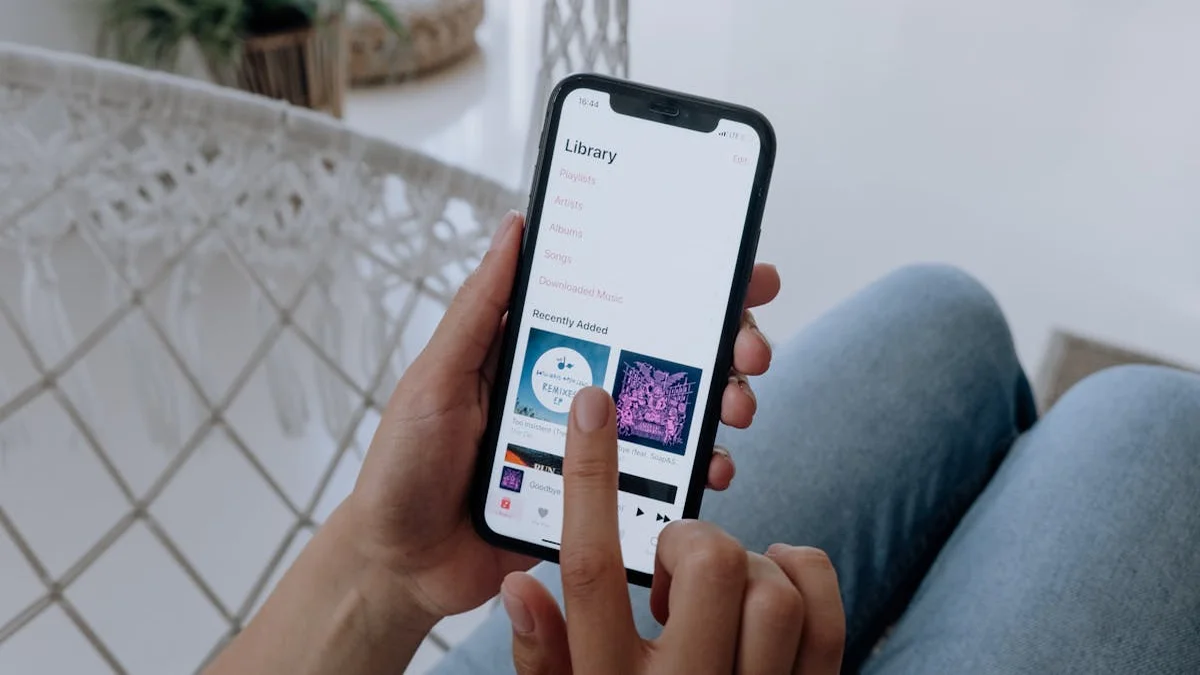
The Hidden Costs of Streaming Your Concentration
Streaming services are engineered for discovery and retention, not for providing a stable, predictable auditory environment. Every time you press play on a cloud-based focus track, you’re initiating a complex chain of events that works against your productivity.
The Architecture of Interruption:
- Buffer Anxiety: Even with a strong connection, the possibility of a stutter or dropout exists, pulling your mind out of the flow state.
- Playlist Roulette: Algorithmically generated playlists can shift mood or intensity without warning, injecting an unexpected vocal track or upbeat rhythm into your calm.
- The Ad Interruption: On free tiers, ads are the ultimate context switch, violently ejecting you from your work to hear about a product you don’t need.
- Battery Drain: Constant data transmission (download and upload for analytics) and screen-on time to manage the app are among the heaviest drains on your device.
- Data Harvesting: Your listening habits—when you focus, for how long, what “moods” you select—are valuable behavioral data points sold or used to refine advertising profiles.
The average hour of streaming music can use between 50-150MB of data and contributes significantly to the “background drain” that leaves your phone dead by afternoon.
This creates a broken incentive: the companies providing your focus aid are financially motivated to learn about your habits, not to optimize for your uninterrupted success. Their success metrics are monthly active users and listening time, not your completed projects.
The promise of infinite choice becomes a paralysis of endless option. You spend more time curatorially managing your “focus” soundtrack than actually focusing. The solution isn’t a better playlist; it’s removing the entire streaming layer from the equation.

How Audio Can Exist Without the Internet
If the problem is dependency on remote servers and unpredictable data streams, the solution is local generation. This isn’t about downloading MP3 files—that just trades streaming loops for predictable, repetitive audio that the brain eventually tunes out or becomes irritated by. The next step is procedural audio generation.
Think of it not as playing a recording, but as deploying a tiny, sophisticated audio engine directly onto your phone’s processor. This engine uses mathematical algorithms to generate sound waves in real-time.
Here’s how it works in practice:
- Seed Parameters: You select a base soundscape—“rainforest,” “coffee shop,” “binaural beats at 40Hz.”
- Real-Time Synthesis: Your device’s audio chip uses these parameters as a recipe to generate the audio waveform on the fly.
- Non-Repetitive Sound: Because it’s generated mathematically with controlled randomness, the sound never loops identically. The rain patter has infinite variation; the coffee shop murmur never repeats the same conversation.
- Zero Data Transfer: After the initial app download, no bits travel over the network. The music comes from your phone’s internal computation, not a distant server.
The technical and user benefits are immediate:
- Battery Efficiency: Generating simple waveforms locally uses a fraction of the power required for cellular or Wi-Fi radio transmission.
- Instantaneous Playback: No buffering, ever. The sound starts the millisecond you tap the screen.
- Infinite Variety: You’re not limited to a pre-recorded library. The combinations of sound layers, frequencies, and textures are boundless.
- Absolute Privacy: No server ever knows you’re trying to focus. No profile is built. The activity begins and ends on your device.
After researching dozens of productivity apps, one pattern stands out: the most effective tools are often the simplest and most self-contained. They respect the device’s capability to handle complex tasks—like audio synthesis—without begging a remote server for permission. This is the same principle behind the broader local-first software movement—tools that work on your device first, with no cloud dependency.
Debunking 3 Myths About Offline Focus Tools
When presented with a self-contained alternative, several objections typically arise. Let’s address them head-on.
Myth 1: “Offline audio must be low-quality or limited.” This confuses offline playback with offline generation. Playing a low-bitrate MP3 on a loop is limited. Using your device’s native audio engine (the same one used by high-end music production apps) to generate lossless, complex soundscapes in real-time is not. The quality is limited only by your device’s hardware, which is more than capable.
Myth 2: “I need the variety of streaming services.” Do you need variety of content, or variety of sound? Streaming offers millions of different tracks, but for focus, you likely seek a specific, consistent auditory profile. Procedural generation offers infinite variety within the sound profile you choose—the rainforest never sounds the same twice, yet it’s always a rainforest.
Myth 3: “It’s just a niche for privacy fanatics.” While privacy is a cornerstone benefit, the primary advantage is functional reliability. It’s for anyone who has:
- Worked on a plane or in a basement with poor signal.
- Had their focus shattered by a surprise ad.
- Watched their phone battery plummet during a long work session.
- Felt annoyed by the repetitive loop of a 30-minute “focus” track.
We believe productivity tools should work offline by default. The core function—aiding concentration—is inherently compromised by any external dependency. The tool should be a servant to your intent, not a gateway to a network of distractions.

Building Your Own Distraction-Free Audio Setup
You don’t need to wait for a specific app. You can architect a more focused audio environment today by applying these principles. The goal is to minimize decision points, external requests, and unpredictable inputs.
1. Audit Your Current Stack:
- What apps do you use for focus audio? Note their requirements (internet, subscriptions).
- Use your device’s battery usage monitor to see which audio apps are the most demanding over 7 days.
- Notice the points of friction: When do you pause to skip a track? When are you interrupted?
2. Explore Offline-First Alternatives: Look for apps that prioritize local generation or offer full soundscape downloads. Keywords to search include “procedural audio,” “offline soundscapes,” or “generative ambient.” The hallmark is that once installed, they require no permissions beyond maybe local storage and should function in Airplane Mode.
3. Integrate with a Physical Timer: The most powerful focus system combines auditory and temporal boundaries. Use a simple, offline Pomodoro timer (or even a physical kitchen timer) alongside your soundscape. The combination of a time-bound session and a consistent, non-intrusive sound environment is far more effective than either element alone. This creates a ritual that signals to your brain it’s time for deep work.
4. Embrace Constraint as a Feature: Having 50 perfect, offline-generated soundscapes is infinitely more productive than having access to 50 million streaming tracks that come with baggage. The limitation—no internet required—is the very feature that eliminates distraction.
Most productivity apps share a troubling assumption: that your data and your attention are fair exchange for functionality. This is a choice, not a technical necessity. For a task as simple and personal as shaping your auditory environment, your device is already powerful enough to handle it with elegance and in complete isolation.

The Quiet Power of Self-Contained Tools
The pursuit of focus is often cluttered with complex solutions: new subscription services, sophisticated analytics dashboards, and AI coaches. Yet, the most profound gains frequently come from subtraction. Removing the internet from the focus equation isn’t about deprivation; it’s about creating a clean room for your mind to work. It returns agency to you—over your data, your device’s battery, and, most importantly, your attention.
When your focus music comes from the cloud, you are a user in a system designed to learn from you. When it comes from your own device, you are the operator of a precise tool. The difference isn’t just technical; it’s psychological. One model subtly reminds you of the connected world’s demands, while the other builds a wall against them, for a time, by your own choice.
The next time you prepare for deep work, ask yourself: What are you really connecting to? A server farm tracking your session, or the specific mental state you’re trying to achieve? The most effective focus tool is the one that disappears, leaving only you and the work. Achieving that often means disconnecting everything else. If you’re feeling the weight of too many monthly fees for tools that could work locally, you’re not alone—subscription fatigue is real, and there are alternatives.
Ready to experiment with a truly offline approach? Start by putting your device in Airplane Mode the next time you need to concentrate and see what you create. The silence, or the simple, reliable sound you choose to fill it with, might be the most productive upgrade you make all year.
Believe software should work without a connection? Zeroed brings the same offline-first philosophy to your finances—no subscription, no cloud dependency.
Try Zeroed Free